


trinasco GmbH’s experience from customer projects involving household articles and textiles
Since August 12, 2026, the EU Packaging Regulation (EU) 2025/40 – the PPWR for short – has applied directly in all Member States. It replaces the Packaging Directive 94/62/EC, which set the framework for around three decades. The date of application was not postponed, despite unresolved questions of interpretation and demands from industry.
trinasco GmbH advises many companies from a wide range of industries on implementation. This article describes our approach in six steps and answers the questions we encounter most frequently in our projects. The examples come from two projects: a gift set with household articles and the packaging used by a shirt supplier.
The article is divided into three parts. They build on one another – the experience from the projects is difficult to classify without the process, and the questions at the end come directly from those projects. Each part can nevertheless also be read on its own.
Anyone who came here with a specific question will find the answer fastest in Part 3. Each answer there is written so that it remains understandable without the preceding parts.
This part describes what the PPWR requires of companies and how it can be worked through: from clarifying one’s own role and classifying the packaging to the six steps we apply in our projects – from the packaging inventory to the signed Declaration of Conformity.
This distinction comes first because everything that follows remains ambiguous without it. The PPWR uses two role designations that mean the same thing in everyday German, but trigger different obligations in legal terms.
| Role | Who is this? | What follows from it? |
|---|---|---|
| Producer Art. 3(1)(13) | Anyone who manufactures packaging or a packaged product – or has it developed or manufactured under their own name or trademark. | Conformity assessment (Art. 38), technical documentation (Annex VII), EU Declaration of Conformity (Art. 39) |
| Manufacturer Art. 3(1)(15) | Anyone who makes packaging or packaged products available for the first time within the territory of a Member State – or unpacks packaged products without being an end user. | Extended producer responsibility (EPR): registration in the producer register, quantity reporting, waste-management contributions |
A company can be both at the same time. But it can also be a producer without being a manufacturer – and vice versa. Anyone who fails to distinguish between the roles will look for the Declaration of Conformity in the wrong place or report quantities that they do not have to report at all.
Once the roles have been clarified, the actual implementation follows. In our projects, it proceeds through six steps that build on one another: without an inventory there is no prioritization; without a list of requirements there is no targeted supplier request; without verified evidence there is no Declaration of Conformity.
The first question is not “Which requirements apply?” but “What do we place on the market – and what function does it have?” The PPWR distinguishes packaging by its function, not by its material. The same cardboard box can be sales, grouped or transport packaging depending on how it is used. The classification determines which obligations apply: the harmonized labeling under Art. 12, for example, does not apply to transport packaging – but it does apply to e-commerce packaging, which is legally a subcategory of transport packaging.
It does not apply immediately either: labeling under Art. 12 is expected to apply from August 12, 2028, and in any event only 24 months after the entry into force of the implementing act that establishes the symbols (see Table 5). This act has not yet been adopted. At the beginning of 2026, the Commission’s Joint Research Centre (JRC) submitted a technical proposal for a system of pictograms, color coding and text, which is currently being discussed; it is not binding.
A systematic review of the entire range along the six packaging categories in Art. 3 PPWR has proven effective:
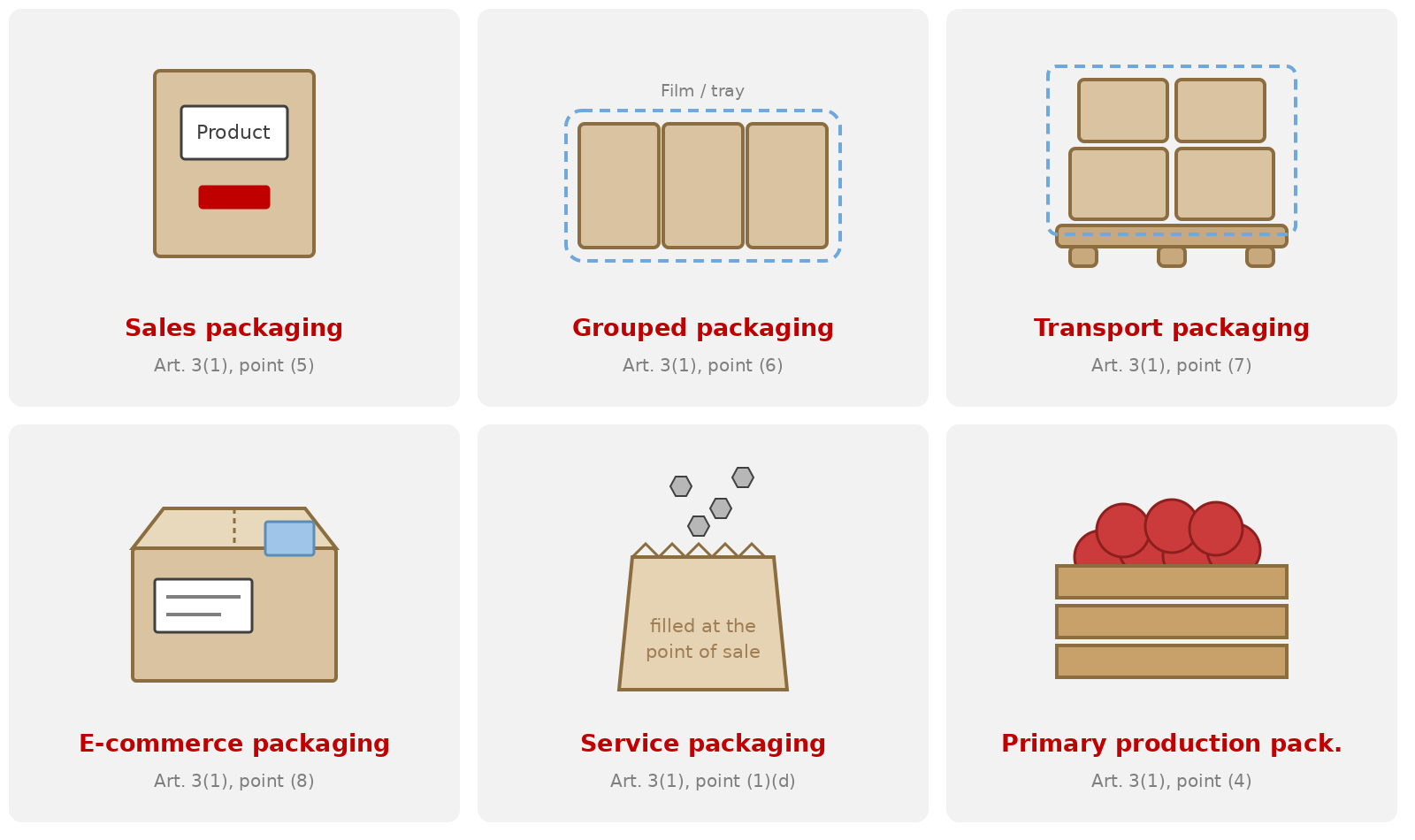
| Category | Definition (abbreviated) | Examples from our projects |
|---|---|---|
| Sales packaging Art. 3(1)(5) | Forms a sales unit of product and packaging for the end user at the point of sale (formerly: primary packaging). | Gift-set box including inserts; polybag with collar support, clips and labels for a shirt |
| Grouped packaging Art. 3(1)(6) | Groups several sales units together at the point of sale – for sale to end users, for restocking shelves, or as a storage or distribution unit; removable without affecting the product. | Cardboard tray with six gift boxes for shelf stocking; inner carton with ten individually packaged shirts |
| Transport packaging Art. 3(1)(7) | Facilitates the handling and transport of sales units or grouped packaging and prevents transport damage; containers for road, rail, sea and air are excluded. | Shipping carton to the retailer, pallet, stretch film, strapping; master carton from procurement |
| E-commerce packaging Art. 3(1)(8) | Transport packaging used to deliver products from online or other distance selling to the end user. | Online shop shipping carton including filling material; shipping bag for clothing |
| Service packaging Art. 3(1)(1)(d) | Designed to be filled at the point of sale and used to hand over the product. | Paper or plastic carrier bag at the checkout |
| Primary production packaging Art. 3(1)(4) | Packaging for unprocessed products from primary production (within the meaning of Regulation (EC) No 178/2002). | Generally not relevant in non-food ranges |
Within each category, the individual packaging unit is considered (Art. 3(1)(45) PPWR): the unit made up of all components that together perform a packaging function. For the packaged shirt, this is not just the polybag, but the bag, collar support, clips and labels together. Three further terms also appear in Art. 3(1) PPWR:
This distinction determines how recyclability is assessed, which weights by material are included in EPR reports, and which evidence is needed from the supplier. In our two projects, the review resulted in seven components for the gift-set box and five for the packaged shirt – plus a sewn-in care label that is not packaging.
The result of Step 1 is a matrix: each row represents a packaging unit, and each column a product with which it is placed on the market. It almost always becomes clear that a large product range can be reduced to significantly fewer packaging units – and that is where efficiency is created: a packaging unit is documented once and applies to all assigned products.
| Packaging unit \\ Product | Gift set variant A (e.g. 4 pieces) | Gift set variant B (e.g. 3 pieces) | Individual accessory item |
|---|---|---|---|
| Gift-set box (sales packaging) | ● | ● | – |
| Outer carton, six-pack tray (grouped packaging) | ● | ● | – |
| Shipping carton (e-commerce packaging) | ● | ● | ● |
| Pallet & film (transport packaging) | ● | ● | ● |
The two gift-set variants differ only slightly in their contents and are delivered in the same packaging unit. It is therefore documented only once. The same applies to grouped, e-commerce and transport packaging.
For manageable ranges, all packaging units can be processed in parallel. With several hundred items, an order is needed. One important point in advance: prioritization determines the order in which work is carried out – not whether it is carried out. Every packaging unit placed on the market must comply with the PPWR. The first criterion is the most important because it determines the scope of all further obligations:
| Criterion | Key question | Why it matters |
|---|---|---|
| Role in the market | Are we the producer, importer or distributor for this packaging – and the manufacturer for EPR purposes? | Determines the scope of obligations: only as a producer are we responsible for conformity assessment, technical documentation and the Declaration of Conformity. As an importer or distributor, there are primarily inspection and due-diligence obligations (Arts. 18 and 19) |
| Quantity | How many units do we place on the market? How many products is the packaging assigned to? | Greatest impact per packaging unit processed; basis for EPR reports |
| Materials and substances | Plastic, composite, material mix? Printing inks, coatings, adhesives? | More substance and recycling questions, more evidence; for plastic, recycled-content requirements also apply from 2030 |
| Supply chain | How many suppliers, and where are they based? Is the packaging sourced directly or through the product supplier? | Lead times for evidence are often the critical path – especially in multi-stage supply chains |
| Control risk | Is it sold online or imported from a non-EU country? Are substance limits easy to verify? Is the packaging visible to consumers? | Online trade and imports are a focus of coordinated controls; registration and documents may be requested at any time |
| Target markets | Which Member States are supplied? | National EPR systems and labels (e.g. Triman and Info-tri in France) |
| Range dynamics | Which new developments or relaunches are planned? | Design new packaging to be PPWR-compliant from the outset instead of retrofitting it later |
If role, material, supply chain and control risk are combined into a regulatory risk and set against quantity, four quadrants – and therefore an order – emerge:
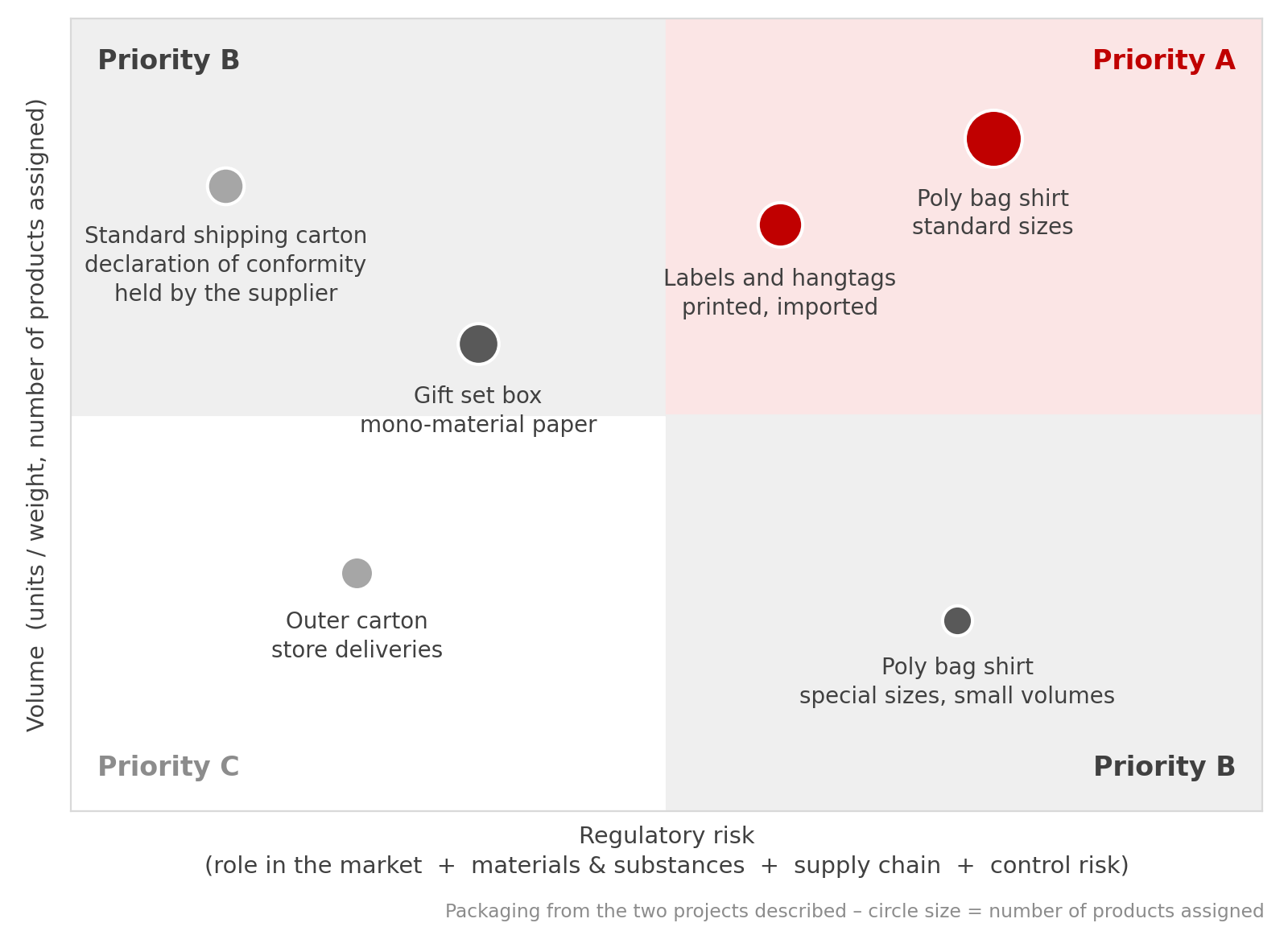
There is currently no official list of the types of packaging that authorities are focusing on particularly. What can be substantiated is that the Commission is taking a warning-first approach at the outset. In Germany, the Central Agency Packaging Register primarily monitors registration, reporting and EPR obligations; the authorities responsible under state law conduct on-site inspections. At EU level, the Commission has declared coordinated controls of products sold online and imported products a priority.
This results in an increased control risk for online channels and imports from non-EU countries, as well as for packaging whose substance limits can be readily verified in a laboratory.
For this step, we use the market-leading Product Compliance platform. What matters for the PPWR is that it allows not only products but also packaging to be created and processed as separate objects. Based on the packaging category, materials, components, target markets and the time of marketing, the platform generates a list of requirements that covers not only the PPWR but also substance law, national requirements, standards and voluntary standards.
The time of marketing is decisive, because the PPWR introduces its obligations in stages: the same packaging must meet different requirements today than from 2028 or from 2030.
The efficiency gain lies in the linking: the packaging is connected to the associated products – the matrix from Step 1 is mapped directly in the system. Evidence is stored once with the packaging and is available for all linked products. If a legal act changes, for example through new entries in the REACH Candidate List, the list of requirements is updated.
The platform thereby covers two obligations that have applied since August 12, 2026: before placing packaging on the market, the producer must carry out a conformity assessment procedure (Art. 38), prepare technical documentation under Annex VII and – if conformity has been demonstrated – issue an EU Declaration of Conformity under Art. 39. The old Packaging Directive did not provide for a formal Declaration of Conformity for packaging.
Neither is created as a separate Word document; both are generated from the same data as the list of requirements. The declaration can be generated in all official EU languages – practically relevant because it must be translated into the language of the Member State in which the packaging is placed on the market; English alone is not sufficient. It can also be linked to the company’s own website or a Product Information Management (PIM) system, so that business partners and authorities always see the current version.
For the gift-set box targeting Belgium, France, Italy and Spain, the list of requirements comprises 41 individual requirements. What sounds like a lot quickly falls into place:
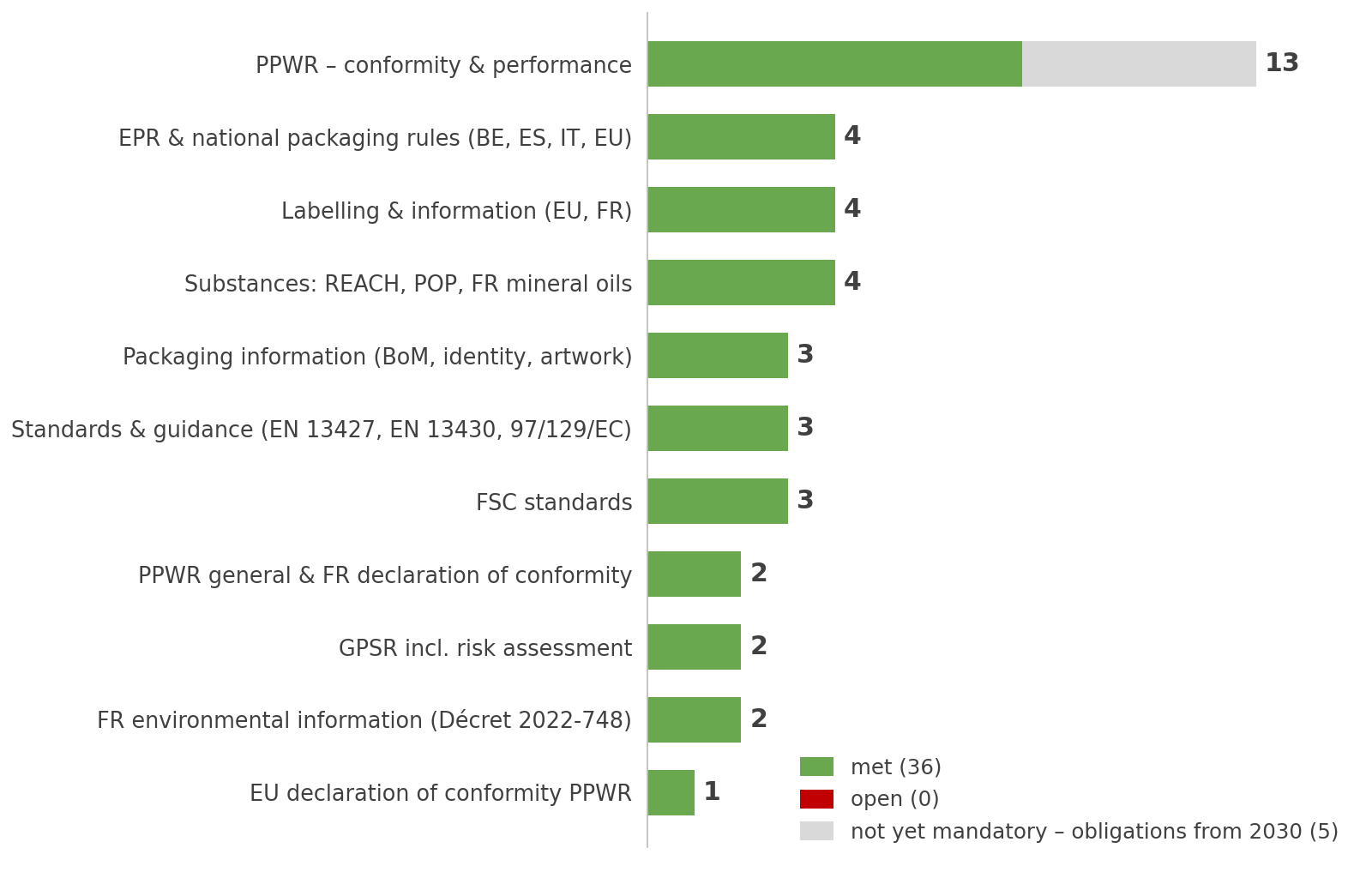
Five requirements are marked as “not yet mandatory” – those that will apply only from 2030 or later. They remain visible and can be activated in good time. Two documents prove particularly valuable. The bill of materials is the basis for all assessments and EPR reports. The identity declaration – also called an identification certificate – proves that the packaging delivered is the same as the packaging to which the test reports refer.
Why this is necessary is shown by a typical case from packaging procurement: a film manufacturer produces PE film under its internal designation and supplies it to several customers – each under its own item number, and some under its own name. The heavy-metal test report is issued under the manufacturer’s internal designation. For our client, this report cannot be used without a connecting document, because there is no way to prove that its bag variant and the tested film are the same material. The identity declaration provides precisely this bridge.
Without it, an otherwise valid test report cannot be assigned to a specific packaging unit.
| Date | Requirements (selection) |
|---|---|
| 12.08.2026 | Date of application: substance requirements under Art. 5, recyclability as a principle, conformity assessment, technical documentation and EU Declaration of Conformity, producer register and EPR |
| 12.08.2026 – 31.12.2029 | Transitional rule for minimization: the basic requirements of Directive 94/62/EC continue to apply; in practice, standard EN 13428 (Art. 70(1)(b)) |
| 12.02.2028 | Empty space in sales packaging reduced to the necessary minimum (Art. 24) |
| 12.08.2028* | Harmonized labeling with information on material composition (Art. 12) |
| 01.01.2030* | Recyclability grades A–C (Art. 6), minimum recycled content in plastic packaging (Art. 7), minimization under Annex IV (Art. 10), max. 50% empty space in grouped, transport and e-commerce packaging (Art. 24) |
| 01.01.2038 | Only recyclability grades A and B permitted |
Under Art. 16 PPWR, suppliers of packaging and packaging materials must provide the producer with all information and documents needed for the proof of conformity, including the technical documentation under Annex VII. The list of requirements from Step 3 makes the request precise: we do not ask generally for “PPWR compliance”, but specifically for the documents that cover individual requirements.
| Evidence | Covers (selection) |
|---|---|
| Bill of materials with material and weight for each component | Classification of the packaging unit, composite assessment, EPR reports, minimization |
| Heavy-metal test report (including printing inks, adhesives) | Art. 5(4) PPWR |
| REACH and POP declarations of conformity | SVHC Candidate List, REACH Annex XVII, POPs Regulation |
| Printing-ink specification | Absence of mineral oils for France, substances of concern |
| Evidence of recyclability | Art. 6(1) PPWR, EN 13430 |
| FSC certificate (Chain of Custody) | Entitlement to use FSC labels and claims |
| Identity declaration with item numbers and drawings | Evidence that the packaging delivered is identical to the tested sample |
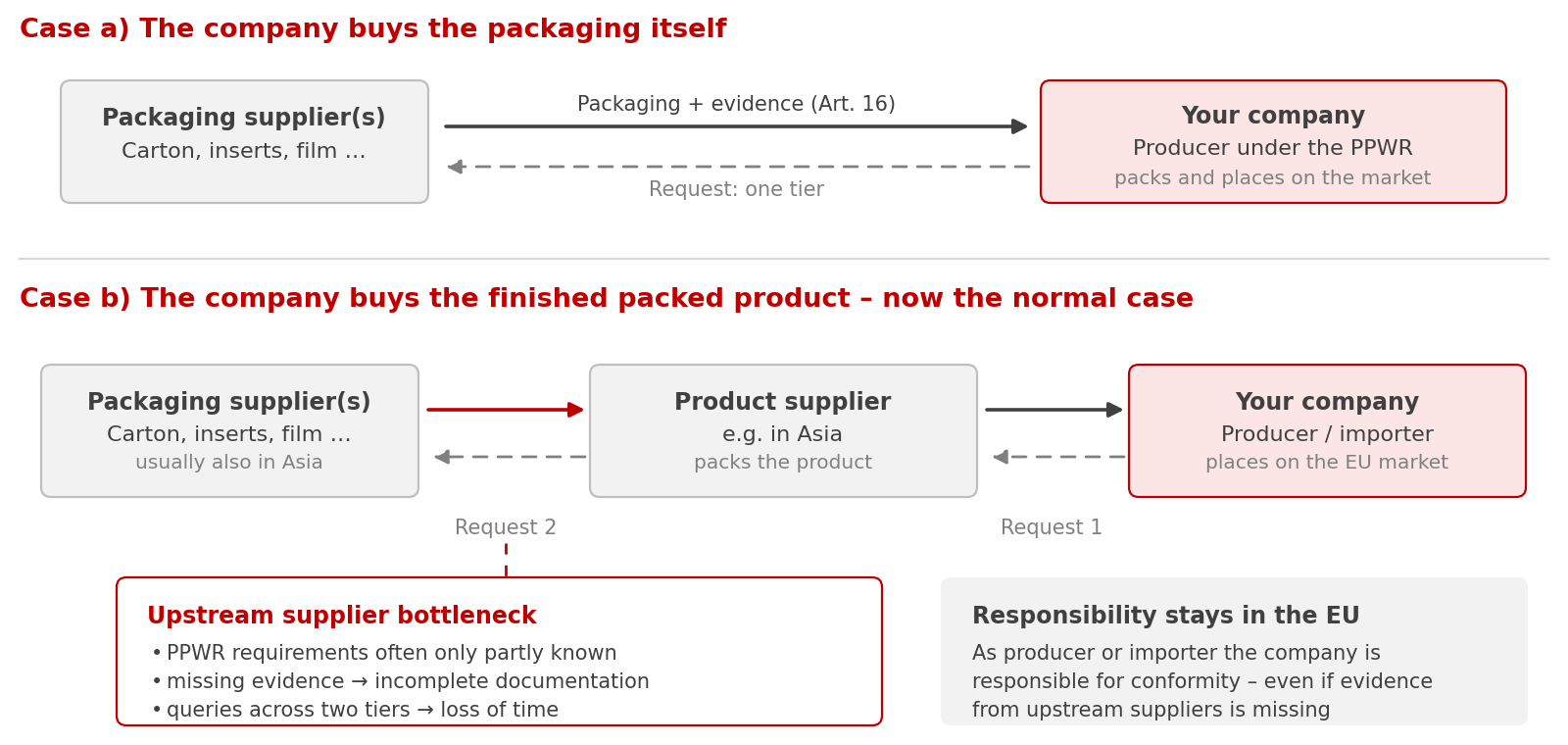
In our projects, Case b) is the standard situation – and this is where the greatest challenge in implementing the PPWR lies. The product manufacturer generally does not produce the packaging itself, but in turn sources it from one or more packaging suppliers. It therefore has to request the documents from its upstream suppliers. In the case of Asian product suppliers, these upstream suppliers are usually also based in Asia and are rarely fully informed about the PPWR requirements.
If documents from the upstream supplier are missing, the packaging documentation remains incomplete – or it is created only with a considerable loss of time because every follow-up question has to pass through two tiers. This does not change who is responsible: anyone who has products manufactured under their own name or trademark is a producer, even if they do not produce a single piece of packaging themselves.
What helps in Case b):
Ideally, all components of a packaging unit would come from one supplier – then one set of documents would be sufficient. In reality, this is rare: film, cartons, metal goods and printing come from different industries and are purchased wherever the product is assembled. The question is still worthwhile for new developments, because every upstream supplier eliminated saves ongoing maintenance effort.
A folder full of documents is not yet proof of conformity. Every piece of evidence received is checked before being assigned to a requirement. Three questions are central:
| Review criterion | Key questions | Typical deficiencies |
|---|---|---|
| Completeness | Are all components of the packaging unit recorded – including printing inks, adhesives and coatings? Are all requirements covered? Is the document dated and signed? | Only the carton tested, not the printing; components missing from the bill of materials |
| Currency | Does the evidence reflect the current legal status, for example the current status of the REACH Candidate List? Is the test report still representative of current production? Is the certificate valid? | Declarations based on an outdated version of the Candidate List; expired certificates |
| Validity | Is the evidence clearly associated with this packaging (item number, material, color)? Do the test scope, method and limit value match the requirement? Is the issuer traceable? | Test report for a different material; general company declaration without an item reference; individual values instead of the sum of the four heavy metals |
This is where the preliminary work pays off: the identity declaration links the company’s own item number to the designation on the test report, while the list of requirements shows the outstanding gaps. Every verified piece of evidence is assigned directly to the relevant requirement, so the processing status is visible at all times. Incomplete evidence is returned to the supplier with a specific follow-up question – not with a general “please improve this”.
Once all applicable requirements are supported by verified evidence, the conformity assessment is complete. The producer issues the EU Declaration of Conformity under Art. 39, whose structure is specified in Annex VIII. The technical documentation under Annex VII forms the basis and must remain available for market surveillance.
Who signs – and who is liable? The declaration is signed on behalf of the producer. To the outside world, the company therefore stands behind the fact that the packaging meets the requirements.
For the people who sign, however, the matter is not over. Anyone who releases packaging without checking the requirements and the evidence bears a personal risk – in two ways.
First, liability towards the company itself. Managing directors owe it the diligence of a prudent businessperson (§ 43 GmbHG). If the company later incurs a fine, a recall or a contractual penalty, the shareholders can claim precisely this damage from the managing director.
Second, fines for breach of supervisory duties. They are imposed under §§ 9, 130 OWiG on the responsible person. This can also be a person with specialist responsibility, for example in quality management, if the task was expressly delegated.
Anyone who signs should therefore be able to demonstrate at any time which verified evidence they relied on. What matters is not the signature itself, but the documented process behind it.
Because the technical documentation and Declaration of Conformity are generated from the same data as the list of requirements, this step is not a separate major project, but the logical consequence of Steps 3 to 5. It is important to keep the declaration up to date: if a packaging supplier changes, a material changes or the legal situation changes, it is reviewed and, if necessary, reissued.
The following two projects come from different industries – and they differ above all in scope. The gift set involved a single sales packaging: a pure cardboard package, albeit with seven components. For the shirt supplier, the entire packaging range had to be recorded – packaging units made from four materials, suppliers in two regions of the world and several sales channels. At the end, we explain what went quickly and what was still open after six weeks.
| Example 1: Household articles | Example 2: Textiles | |
|---|---|---|
| Packaging | Gift-set box made of corrugated board with six cardboard components (belly band, inserts, retaining box) | Polybag with collar support, clips and labels for each shirt; grouped and transport packaging |
| Role under PPWR | Producer – brand name on the packaging | Producer – own brands on polybags and labels |
| Material | Paper, cardboard, corrugated board (monomaterial approach) | Plastic, cardboard, metal (clips), printing inks |
| Target markets | Including Belgium, France, Italy, Spain | Germany, Austria, Switzerland (DACH) |
| Procurement | Packaging supplier in the EU | Suppliers in Eastern Europe (EU) and Asia |
| Result | Complete supplier documents after a few days, EU Declaration of Conformity in less than two weeks | 13 packaging units – after six weeks, almost fully mapped as PPWR-compliant |
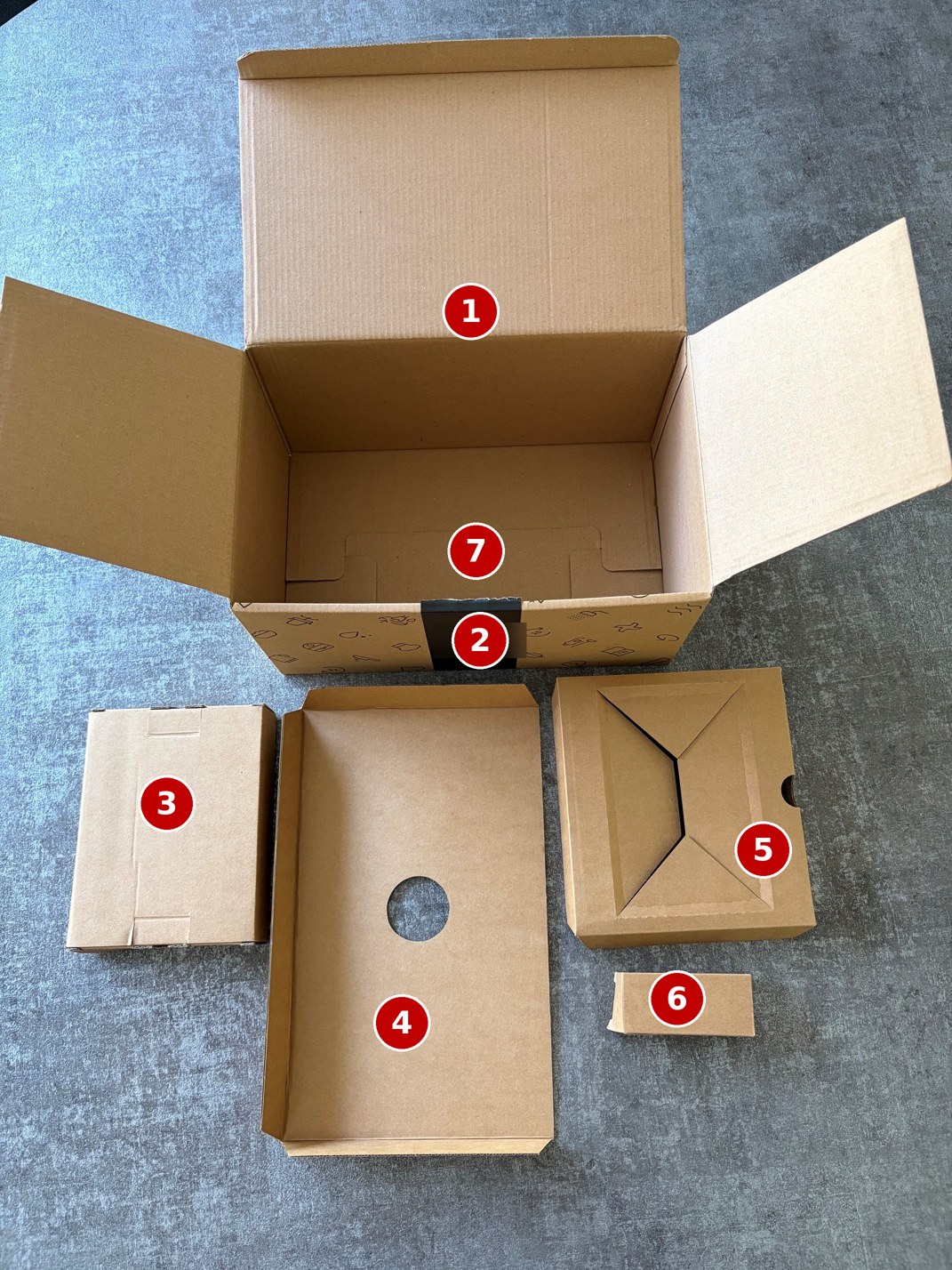
| No. | Component | Function | Classification |
|---|---|---|---|
| 1 | Outer carton made of corrugated board, printed | Containment, protection, presentation | Main part of the packaging unit |
| 2 | Belly band / label | Product information, presentation | integrated or separate – depending on how it is attached |
| 3 | Folding carton | Holds accessories | separate component |
| 4 | Insert tray with cut-out | Fixing, protection | separate component |
| 5 | Retaining box with star cut | Fixing the product | separate component |
| 6 | Spacer | Fixing, cushioning | separate component |
| 7 | Bottom insert | Stabilization, protection | separate component |
At first glance, a simple cardboard package – on closer inspection, a packaging unit with seven components. All are made of paper, cardboard or corrugated board. This means it is not composite packaging, the minimum recycled-content requirements under Art. 7 do not play a role, and the starting position for recyclability is favorable.
We nevertheless recorded two questions in the inventory. First: is the box sent directly to end customers or in an additional shipping carton? This may create a second packaging unit in the e-commerce packaging category. Second: are all inserts necessary to protect the product? From February 12, 2028, empty space in sales packaging must be reduced to the minimum necessary for the function (Art. 24). An insert that protects the product can be justified; one that merely creates volume cannot.
The supplier sources its shirts in two ways: some from suppliers in Eastern Europe, i.e. within the EU, and others from Asia. The shirts are delivered folded and individually packaged. What looks like “one bag” is a packaging unit made up of several components and materials.
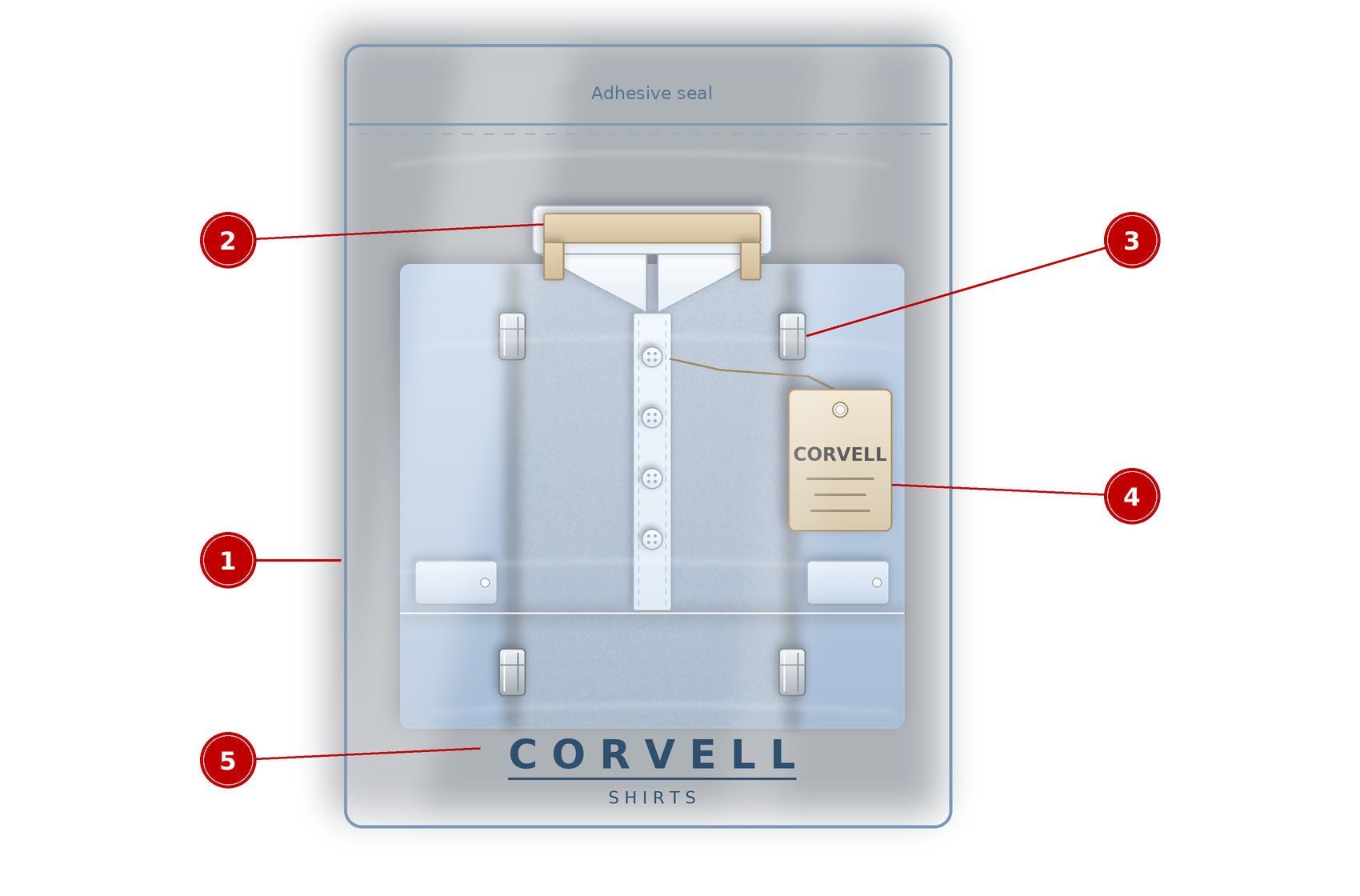
| No. | Component | Function | Material | Classification |
|---|---|---|---|---|
| 1 | Transparent polybag with adhesive closure | Protection against dirt and moisture, presentation | Plastic | Main part of the packaging unit |
| 2 | Collar support / cardboard insert | Collar shape retention | Cardboard | separate component |
| 3 | Needles or clips | Fixing the fold | Metal | separate component – Annex I expressly lists staples as packaging |
| 4 | Hangtag with brand logo | Product and brand information | Cardboard, thread or plastic needle | Packaging under Annex I; attachment determines whether it is integrated or separate |
| 5 | Brand print and label on the polybag | Identification, brand information | Printing ink or paper | integrated component |
| – | Sewn-in care label | Product information | Textile | not packaging – permanently attached to the shirt, without a packaging function |
Because the supplier has polybags and labels printed with its own brands – with different brands depending on the range –, it is a producer under Art. 3(1)(13)(a) PPWR. This applies regardless of who manufactures the bags and in which country.
Together, we reduced the entire range to 10 sales packages, differing essentially in bag size and labeling, and 3 transport packages. That makes 13 packaging units for a much larger product range. These 13 can be created as separate objects in the Product Compliance Management System, linked to the associated articles and documented once each.
For the gift set, the Declaration of Conformity was prepared and signed in less than two weeks. The reason was the supplier: it provided the requested documents in full within a few days. Much of the information was not new – the heavy-metal limit already applied under the old Directive, and corresponding test reports were available. For paper and cardboard packaging, a few documents also cover a large part of the requirements: bill of materials, heavy-metal test report, substance declarations, FSC certificate.
For the textile range, the vast majority had been mapped after six weeks – but it was not complete. Two groups remained open:
This is not a stopgap, but the result of the prioritization from Step 2: first, work is carried out on what quantity and regulatory risk put at the front. After six weeks, the remaining work was therefore exactly where it carried the least weight – with small quantities and with packaging for which the supplier is responsible for the Declaration of Conformity in any event.
Customer statement
“We deliberately tried to begin the work more than six months in advance and standardized and reduced packaging. We also attended numerous webinars and exchanged information with associations. Nevertheless, many practical questions are not clearly answered in the Regulation and the guidelines, and it was not clear to us how to structure the large number of packaging units and link them to the products. trinasco’s packaging inventory and the linking of packaging and products, the preparation of the technical documentation and the Declaration of Conformity via the Product Compliance Management Platform showed us a very efficient way forward.”
Managing Director of a textile company
The following nine questions have come up most frequently in these and other projects. Each answer stands on its own – so you can go directly to the question that concerns you. The answers reflect our approach and do not replace a legal review of the individual case.
Legally, it depends on the sales channel. In practice, we recommended that our client treat the polybag consistently as sales packaging.
There are two theoretical cases: if the end user receives the shirt in the bag – for example, through distance selling –, the bag and shirt form a sales unit and the bag is sales packaging under Art. 3(1)(5). If a specialist shop removes the shirt from the bag and sells it without the bag, the bag never reaches the end user; its function was to protect the shirt during handling and transport, so it would then be transport packaging under Art. 3(1)(7).
Three reasons argue against reproducing this distinction:
Classifying it consistently as sales packaging is the stricter option. It safely covers the online channel and avoids distinguishing between cases. The practical consequence: the labeling obligations under Art. 12, which apply from 2028, are planned for all bags – not only those sold online. Because the client’s brand appears on the bag, it is also the producer of this sales packaging, regardless of the channel.
In most cases, yes. Annex I of the PPWR contains an indicative list that becomes very specific for textiles:
The sewn-in care label is not packaging: it is permanently attached to the shirt and does not perform a packaging function. We explicitly record such distinctions in the inventory – including cases that ultimately are not packaging. The question will arise again at the next audit, and a documented justification saves a second discussion.
Yes. Anyone who unpacks packaged products without being an end user is considered a manufacturer under Art. 3(1)(15)(e) PPWR for the purposes of extended producer responsibility – with registration and reporting obligations for this packaging.
This is everyday practice for the shirt supplier: the goods arrive in large cartons, some of which are unpacked, and their contents are forwarded in the company’s own transport packaging. For the inventory, this means that it records not only the packaging purchased, but also the packaging generated by its own process. This is one of the points at which a packaging inventory becomes larger than expected – and at the same time one at which the work quickly pays off, because otherwise an entire packaging type can pass unnoticed through the net.
The supplier. Anyone who manufactures packaging is its producer – unless someone has it manufactured under their own name or trademark. A standard shipping carton from a packaging manufacturer’s catalog is not made for a specific client. The packaging manufacturer therefore issues the Declaration of Conformity.
The user’s task is to obtain and check it – not to prepare it themselves. The situation is different for specially designed transport packaging or transport packaging printed with the user’s own brand: there, the user is the producer. This distinction has a direct impact on prioritization, as the portfolio in Step 2 shows.
Legally, yes; in practice, not necessarily.
The legal position is clear: a supplier based in an EU Member State is itself an economic operator within the meaning of the PPWR, is directly subject to the Regulation and is accessible for market surveillance. Although the definition of supplier in Art. 3(1)(16) does not distinguish according to registered office, in practice the information obligation vis-à-vis a supplier outside the EU can only be enforced contractually. In addition, upon importation the purchaser itself becomes the importer (Art. 3(1)(17)).
In practice, our textile project showed the opposite. Some suppliers in Eastern Europe had less prior knowledge and a thinner data base than individual suppliers in Asia. It is therefore not safe to assume automatically that documents will be easier to obtain simply because the supplier is based in the EU. The legal starting position is one thing – how well a supplier knows and has documented its own materials is another.
What matters is not when packaging was manufactured, but when it was first made available on the Union market.
This relief is narrowly defined. It concerns the traceability information – not the PFAS limits for food-contact packaging and not the Declaration of Conformity. Anyone relying on it should be able to prove when packaging was first made available: invoices, delivery notes and warehouse data are the usual evidence for this.
For enforcement, the Commission instructs market surveillance authorities to initially request the elimination of non-conformity and provide an opportunity to correct it before prohibitions or recalls follow; an enforcement-oriented approach is to be avoided. This is guidance for the authorities, not a postponement of the date of application.
No, the Declaration of Conformity does not require a list of materials. It refers to the packaging unit – not to a packaging type – and must identify that unit unambiguously. Annex VIII requires a unique identifier for the packaging and a description of the object of the declaration that permits traceability. The materials, on the other hand, belong in the technical documentation under Annex VII, which contains designs, manufacturing drawings and the materials of the components.
In practice, many producers nevertheless include a brief material statement in the description because it makes the packaging unit unambiguous; this is not mandatory.
This has practical consequences far beyond the document. The packaged shirt combines four materials in a single sales unit: plastic, cardboard, metal and printing inks. Because the components can be separated by hand, it is not composite packaging – but each material must appear with its weight in the bill of materials because EPR reports are made by material fraction. From 2030, the plastic content also brings the minimum recycled-content requirements under Art. 7 into play.
Anything not properly recorded in the inventory is ultimately missing from the technical documentation and EPR reports – precisely where the company must demonstrate to retailers and authorities that it knows its packaging.
No. Switzerland is not part of the EU internal market; the PPWR does not apply there directly. In practice, this relieves companies supplying the DACH region: the Swiss restrictions on heavy metals in packaging and packaging components are identical to those in Regulation (EU) 2025/40 – in the type and scope of the regulated heavy metals, the packaging concerned and the exceptions. Packaging that meets the EU requirements may therefore also be placed on the market in Switzerland; the test reports can continue to be used.
Waste management and take-back, by contrast, are governed by Swiss law and must be considered separately.
This depends above all on two things: how well the company’s own range is prepared and how professionally the suppliers cooperate. Both explain why our two projects progressed comparatively quickly.
For the shirt supplier, the preliminary work was decisive. The person responsible had begun at least six months earlier to standardize packaging and reduce additional materials. Without this preliminary work, 13 packaging units would have become significantly more – and six weeks would have become a longer project.
For the gift set, it was the supplier: an established cardboard manufacturer with much of the evidence already available because the 100 mg/kg heavy-metal limit had already applied under Directive 94/62/EC. Anyone who has neither of these prerequisites should plan for a longer lead time. The bottleneck is then almost always the supply chain, not the company itself.
The PPWR is complex, especially for large ranges – but it can be complied with using the right steps and the right tools. The time-critical factor is generally not within the company itself, but with the suppliers and their upstream suppliers. Packaging requirements have never previously been in the spotlight to the same extent as product requirements. The necessary evidence is therefore often not available from packaging producers – it first has to be created, checked or determined in a laboratory. For products sourced fully packaged, every inquiry passes through at least two tiers of the supply chain.
Four prerequisites have proved decisive in our projects:
trinasco GmbH supports you – from the packaging inventory to the signed Declaration of Conformity.
Contact us
trinasco GmbH | produkt-compliance.de
Telephone: +49 (0) 40 46 86 80 00
Email: anfrage@trinasco.comThis article reflects the experience of trinasco GmbH and does not constitute legal advice. Legal basis: Regulation (EU) 2025/40. Status: October 2026.
Book our free initial consultation.
Save €249!

Book our free initial consultation.
Save €249!










Bei den Mühren 1
20457 Hamburg
040 46 86 80 00
Some images on this website were created using AI image generation and serve as illustrative representations of our services.