


Why product compliance is not a cost factor — but protection against existential risks
Anyone responsible for product compliance in a company knows the conversation. The budget is missing, the position is unfilled, the audit is postponed. The argument typically goes: “We’ve never had any problems.” Or: “The risk is manageable.” Or, a particular favourite: “Compliance costs money — and achieves nothing.”
The problem with this argument is not that it is made in bad faith. The problem is that the calculation is incomplete. The costs of compliance are visible — they appear in the budget. The costs of non-compliance, on the other hand, are invisible as long as nothing goes wrong. And when something does go wrong, they are typically far higher than anything saved in previous years by cutting compliance spending.
This article attempts to make the other side of the equation visible — with verifiable figures, documented cases and a sober assessment of what happens when compliance requirements are not met.
Before discussing specific figures, it is worth structuring the cost landscape. Non-compliance is not a single event with a single price tag — it is a bundle of risks that can materialise individually or in combination.
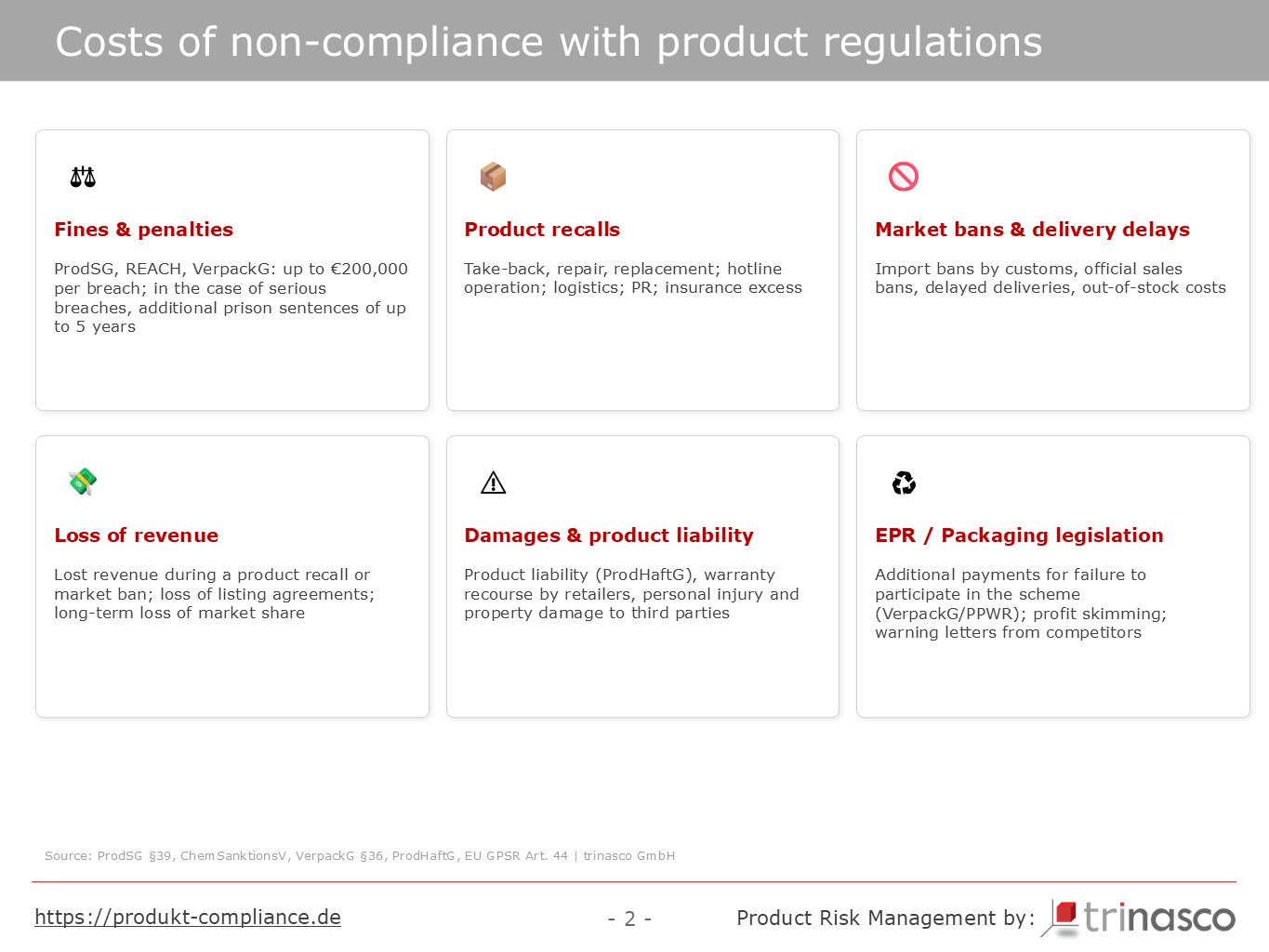
The key cost categories can be grouped into six areas:
Each of these categories can on its own pose an existential threat. In practice they frequently occur in combination: a recall simultaneously triggers revenue losses, liability claims and reputational damage.
Before turning to the actual costs, a brief look at the statutory framework. What authorities are permitted to impose is substantial — even if specific cases rarely become public.
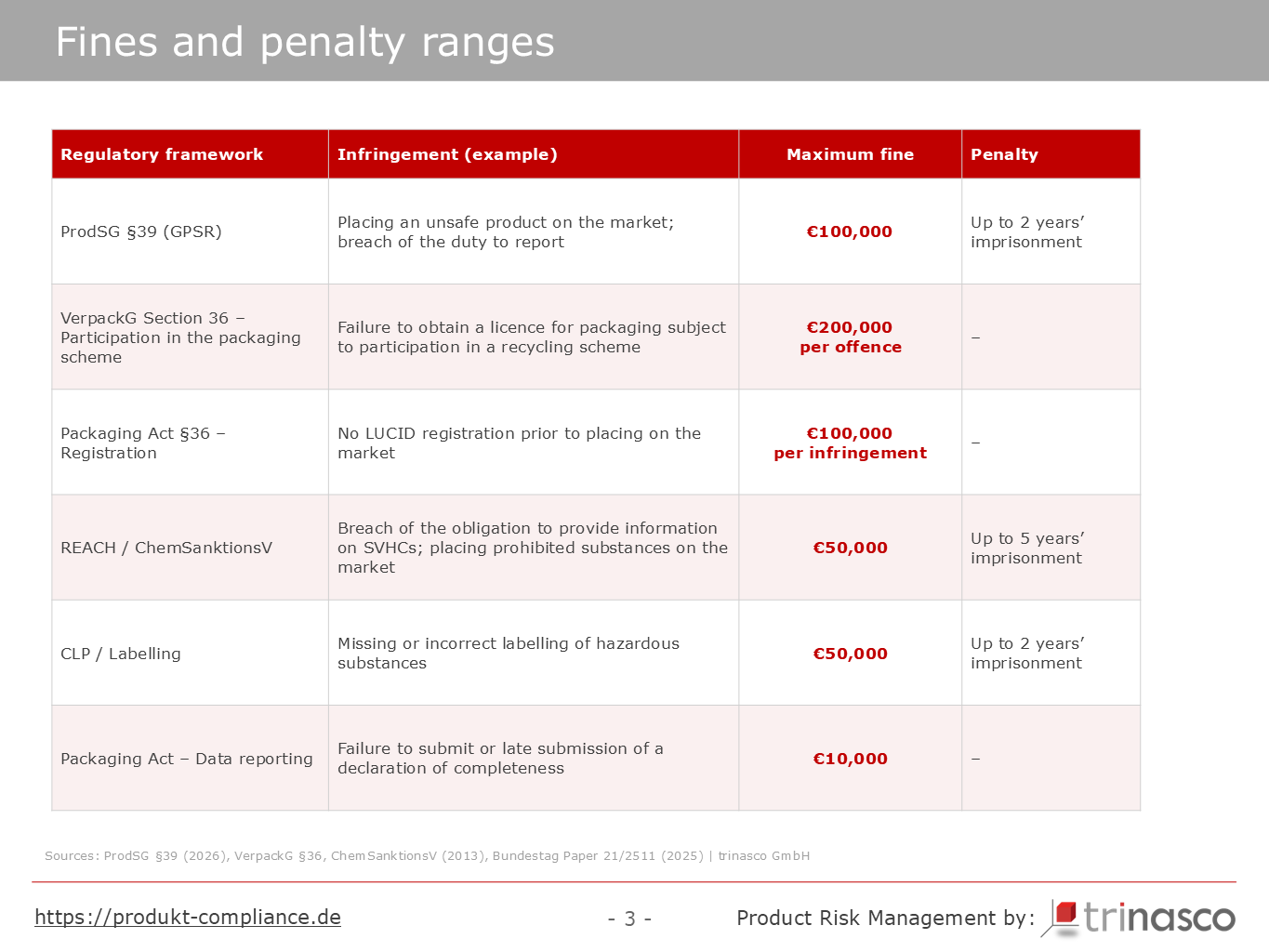
The German Product Safety Act (ProdSG) provides for fines of up to €100,000 for violations of product safety requirements — supplemented by possible custodial sentences in serious cases. The Packaging Act (VerpackG) penalises missing system participation with up to €200,000 per individual violation; the REACH chemicals regulation provides for fines of up to €50,000 and custodial sentences of up to five years.
Why do so few people know of specific cases? The answer is structural: in Germany, the authorities of the 16 federal states enforce the laws independently — there is no central body that aggregates and publishes fine statistics. Unlike under the GDPR, there is no obligation to publish individual cases.
One important exception to this federal principle is the Federal Network Agency (Bundesnetzagentur, BNetzA): it has nationwide sole responsibility for market surveillance under the Radio Equipment Directive (RED, 2014/53/EU — transposed into German law as the Radio Equipment Act, FuAG) and the EMC Directive (2014/30/EU — transposed as the EMVG). For products falling under these two directives — i.e. virtually all electrical and electronic devices with radio components or EMC relevance — there is therefore a single, nationwide enforcement authority.
In 2025, the BNetzA tested more than 2,100 device types in German retail: 58% did not meet the statutory requirements. In total, the authority found fault with 7.7 million devices — and imposed sanctions that, according to its 2025 annual report, amounted to a total in the millions. Individual fines are, however, not publicly identified even by the BNetzA.
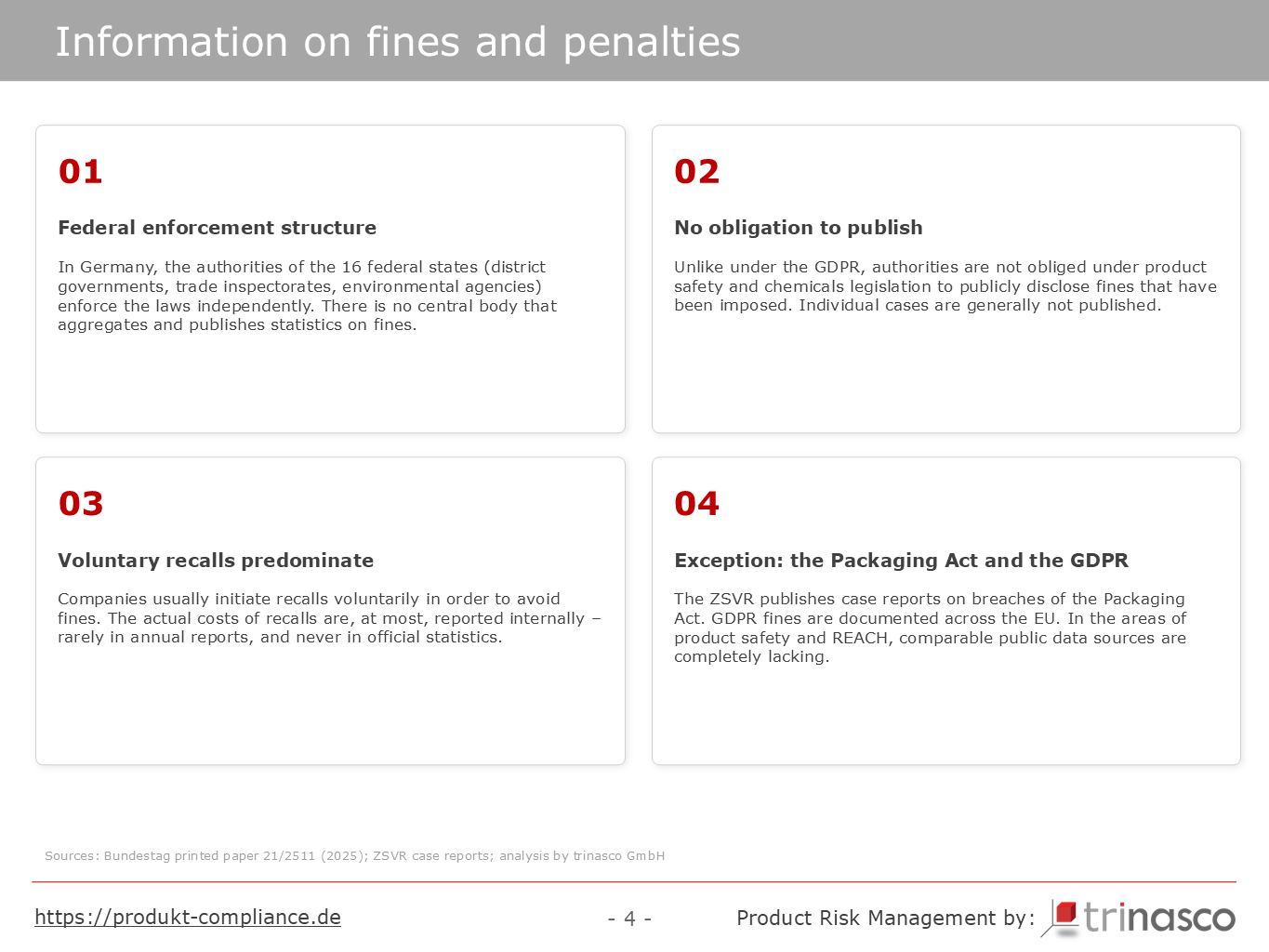
A further exception is the Packaging Act: the ZSVR (Central Packaging Register Office) publishes case reports — and these show what actually happens when companies ignore the requirements. More on this later.
Publicly available data on fines is scarce. We know considerably more about recall costs thanks to the insurance sector — because recalls are insurable, and insurers systematically analyse their claims data.
The most comprehensive published analysis to date comes from Allianz Global Corporate & Specialty (AGCS): the report “Product Recall — Managing the Impact of the New Risk Landscape” from 2017, based on 367 insurance claims from 28 countries and 12 sectors covering the period from 2012 to mid-2017.
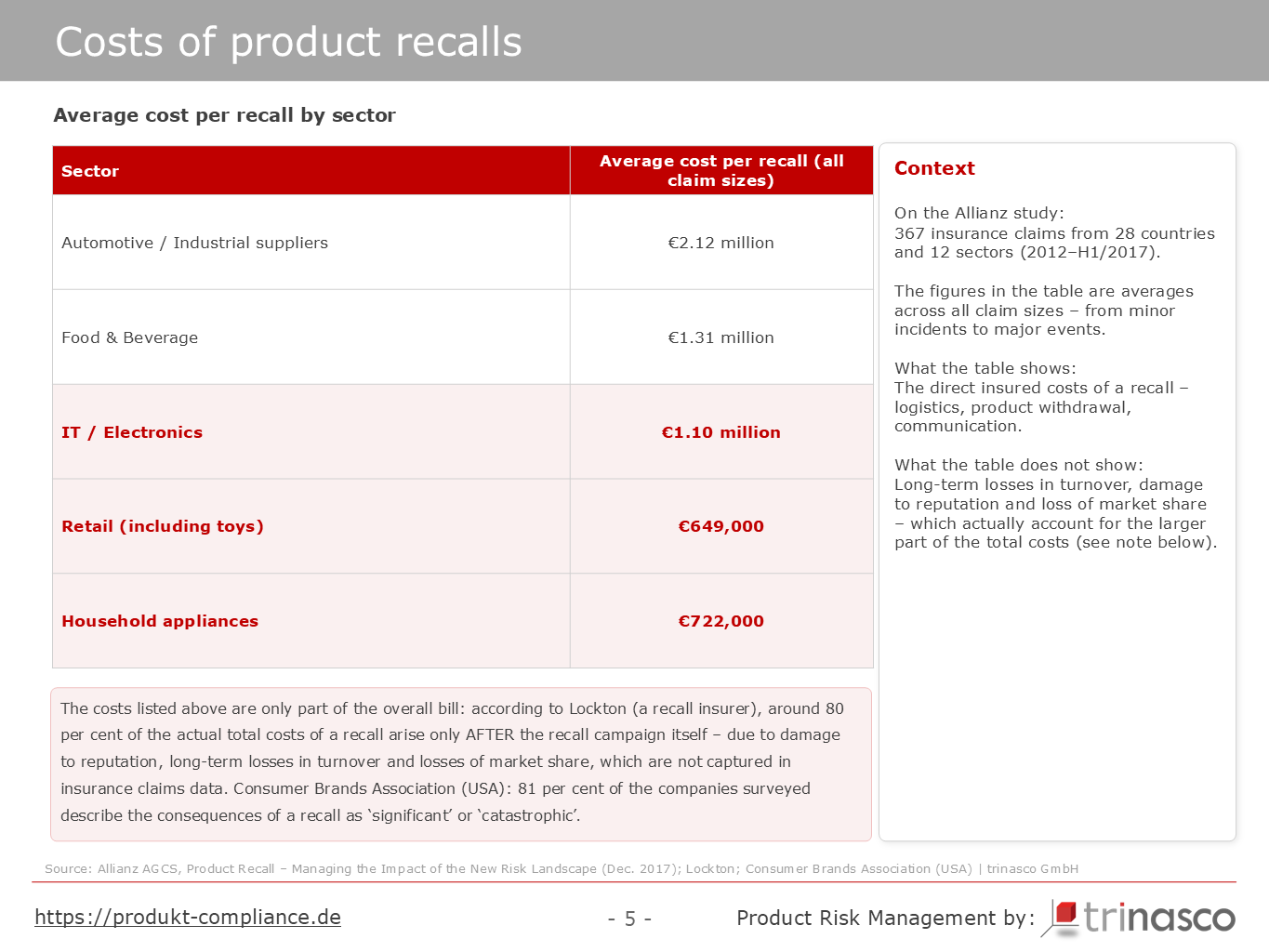
The figures for the most relevant product categories in the non-food consumer goods sector:
Average costs per recall by sector
Source: Allianz AGCS, Product Recall Report 2017 — 367 insurance claims from 28 countries, 2012–H1/2017
Important: These figures cover only the directly insured recall costs — logistics, product retrieval, communications. Not included are long-term revenue losses, reputational damage and loss of market share.
A key finding of the AGCS analysis: over 50% of the total insurance claims volume comes from just 10 individual events. Significant recalls — defined as claims exceeding €5m — account for only 6% of all cases but cause 71% of the total claims sum. The concentration of extreme individual events is the true risk profile.
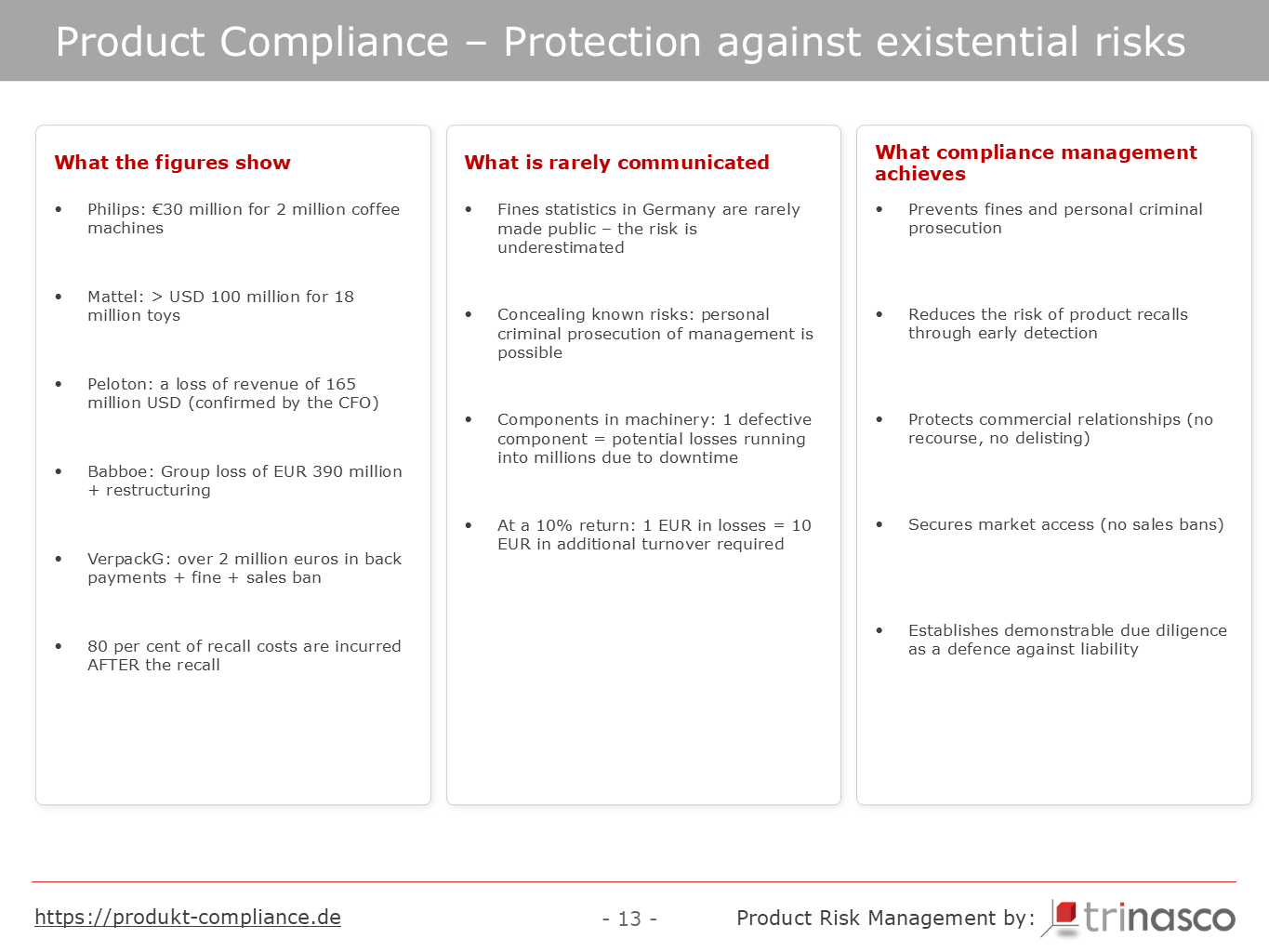
There is a further finding that is often missing from internal compliance discussions: according to recall insurer Lockton, around 80% of the true total costs of a recall arise only after the actual recall action — through reputational damage, long-term revenue losses and market share losses that are captured in no insurance statistic. The direct recall costs are merely the tip of the iceberg.
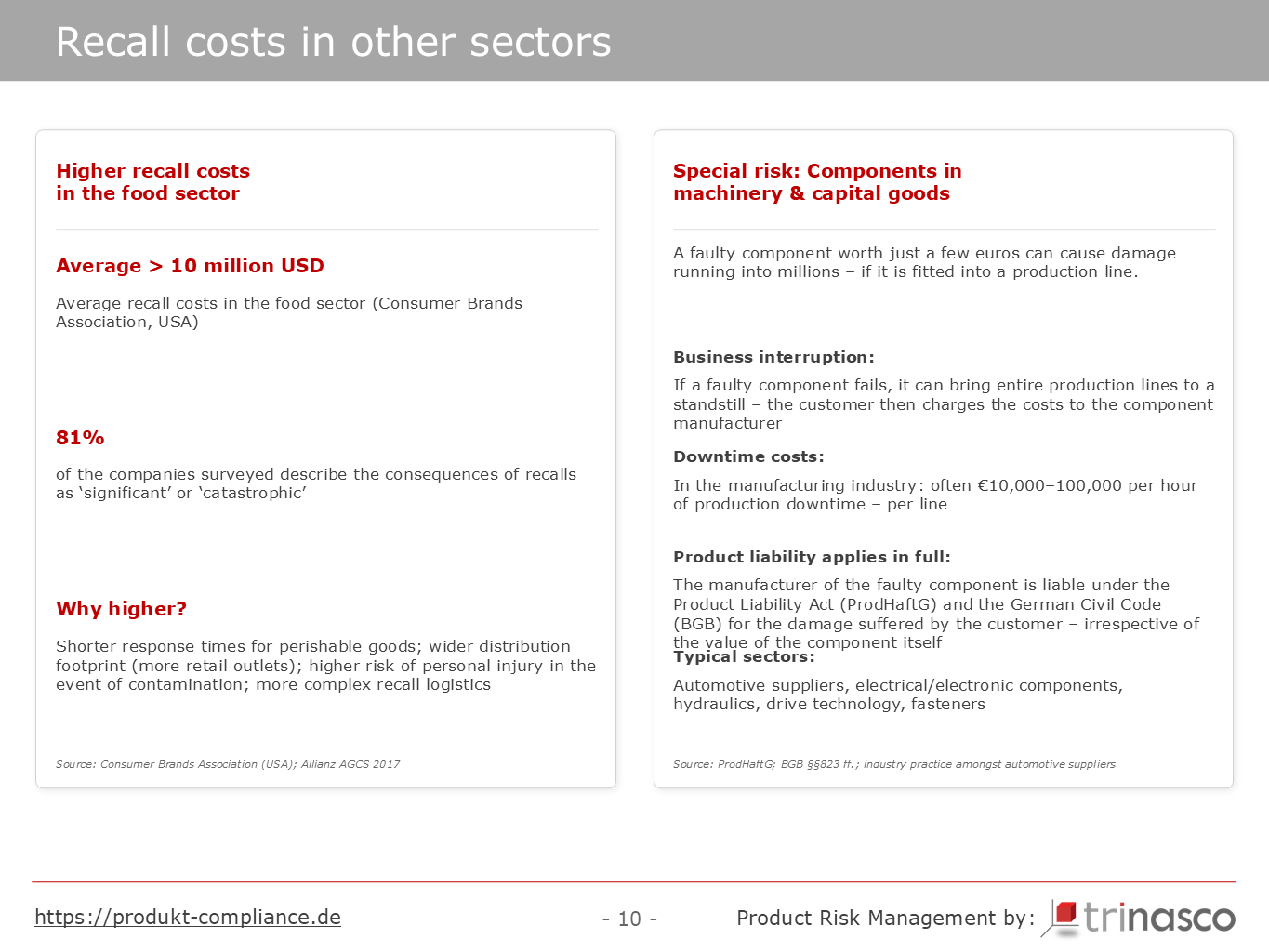
The food sector also merits attention: according to a study by the Consumer Brands Association (USA), recall costs in the food segment average over $10 million — well above the AGCS figures for non-food consumer goods. 81% of companies surveyed described the consequences as ‘significant’ or ‘catastrophic’. The higher costs are explained by the greater logistical effort for perishable goods, shorter response windows, broader market and point-of-sale distribution, and the higher risk of personal injury from contaminated food.
A case frequently underestimated in product liability discussions: products or components that are not sold directly to end consumers but are built into machinery, production facilities or capital goods. If such a component fails, not only the classic recall and replacement costs arise — there is also the risk of business interruption losses at the customer’s premises, which can be charged back to the manufacturer as damages.
In manufacturing industry, the downtime costs of a production line are often in the five-to-six-figure euro range — per hour. A defective component worth a few euros can thus trigger losses running into millions, far exceeding the actual value of the goods. Product liability applies in full: the manufacturer of the defective component is liable for the damage caused to the customer, not just for the value of the goods.
Abstract averages are one thing. More concrete are documented individual cases — events where costs were either communicated by the company itself or can be verified from the reports of listed companies.
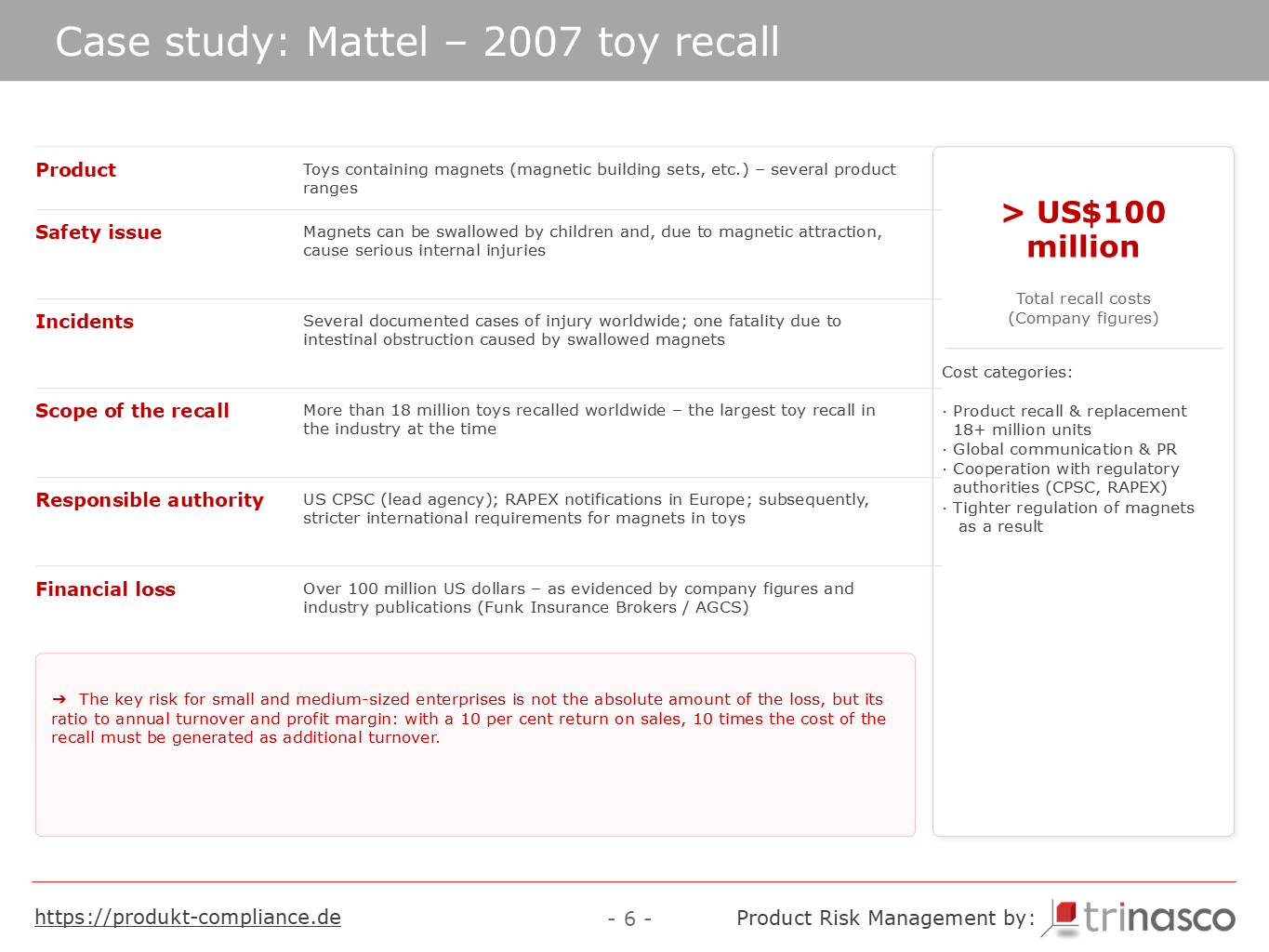
In 2007, Mattel recalled more than 18 million toys — including magnetic construction sets where swallowed magnets could cause serious internal injuries through magnetic attraction. According to company statements and industry publications, the recall cost over $100 million — the largest toy recall in the industry at the time.
The lesson from this case does not lie in the absolute scale of the damage — that was manageable for a company of Mattel’s size. The real lesson is the ratio: at a profit margin of 10%, a company must generate ten times the recall damage in additional revenue to offset the loss. This ratio applies to medium-sized businesses just as much as to a large corporation — except that smaller companies have far less buffer.
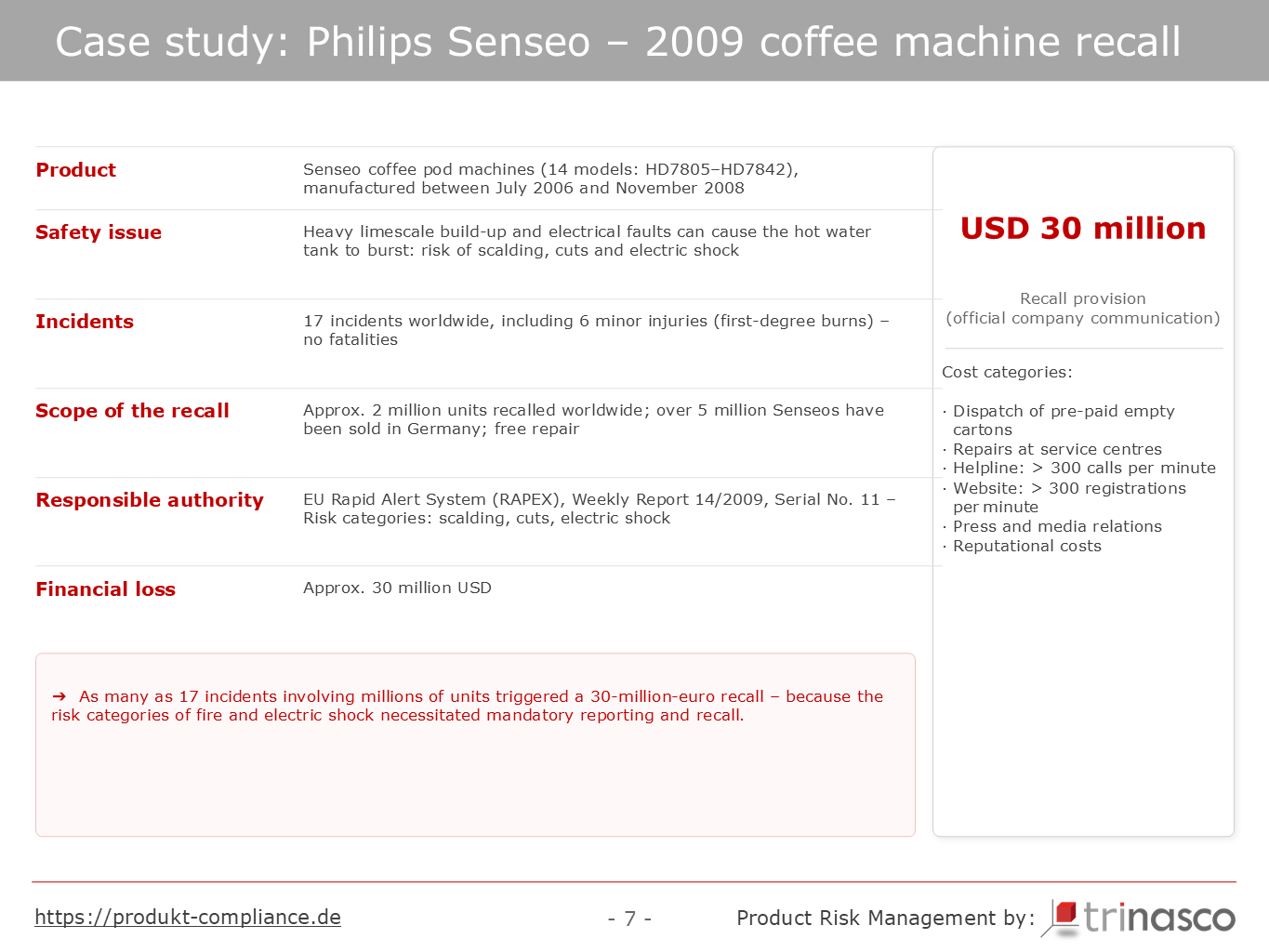
In 2009, Philips recalled around two million Senseo coffee machines. Cause: heavy limescale build-up combined with an electrical fault could cause the hot water boiler to burst — with risks of scalding, cuts and electric shock. The trigger was 17 documented incidents worldwide, of which six resulted in minor injuries.
Philips set aside €30 million for the worldwide recall — communicated to the press by company representatives and documented in the Tagesspiegel on 15 April 2009. The case was reported to the EU rapid alert system RAPEX (weekly report 14/2009).
What this case illustrates: 17 incidents among millions of devices sold is statistically a very small number. Nevertheless, the risk profile — electric shock and scalding hazard — led to a recall costing €30 million. It is the severity of the potential harm, not the frequency of incidents, that determines the recall obligation.
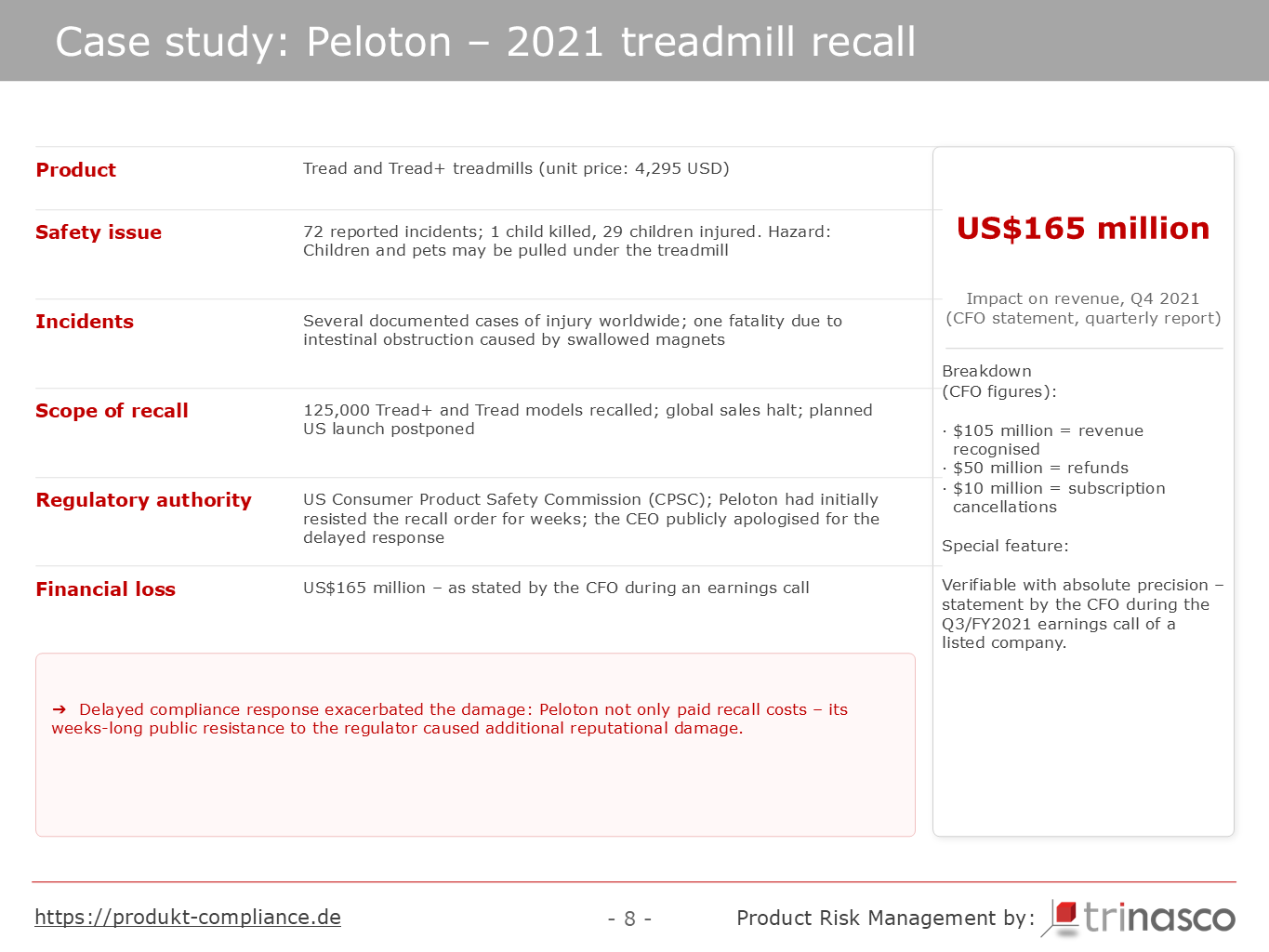
In 2021, Peloton recalled 125,000 treadmills after 72 incidents had been reported — including one child killed and 29 children injured. A particular feature of this case: Peloton had initially resisted the recall demand from the US regulator CPSC for several weeks. The CEO eventually issued a public apology for the delayed response.
The financial consequences were explicitly broken down by the CFO in the Q3/FY2021 earnings call: $105m in lost revenue, $50m in customer refunds, $10m in subscription shortfalls — a total revenue impact of $165m in a single quarter.
The Peloton case illustrates a further connection: resistance to the regulator did not improve the situation — it made it more expensive. A delayed compliance response increases total costs. This applies to recalls just as much as to regulatory audits.
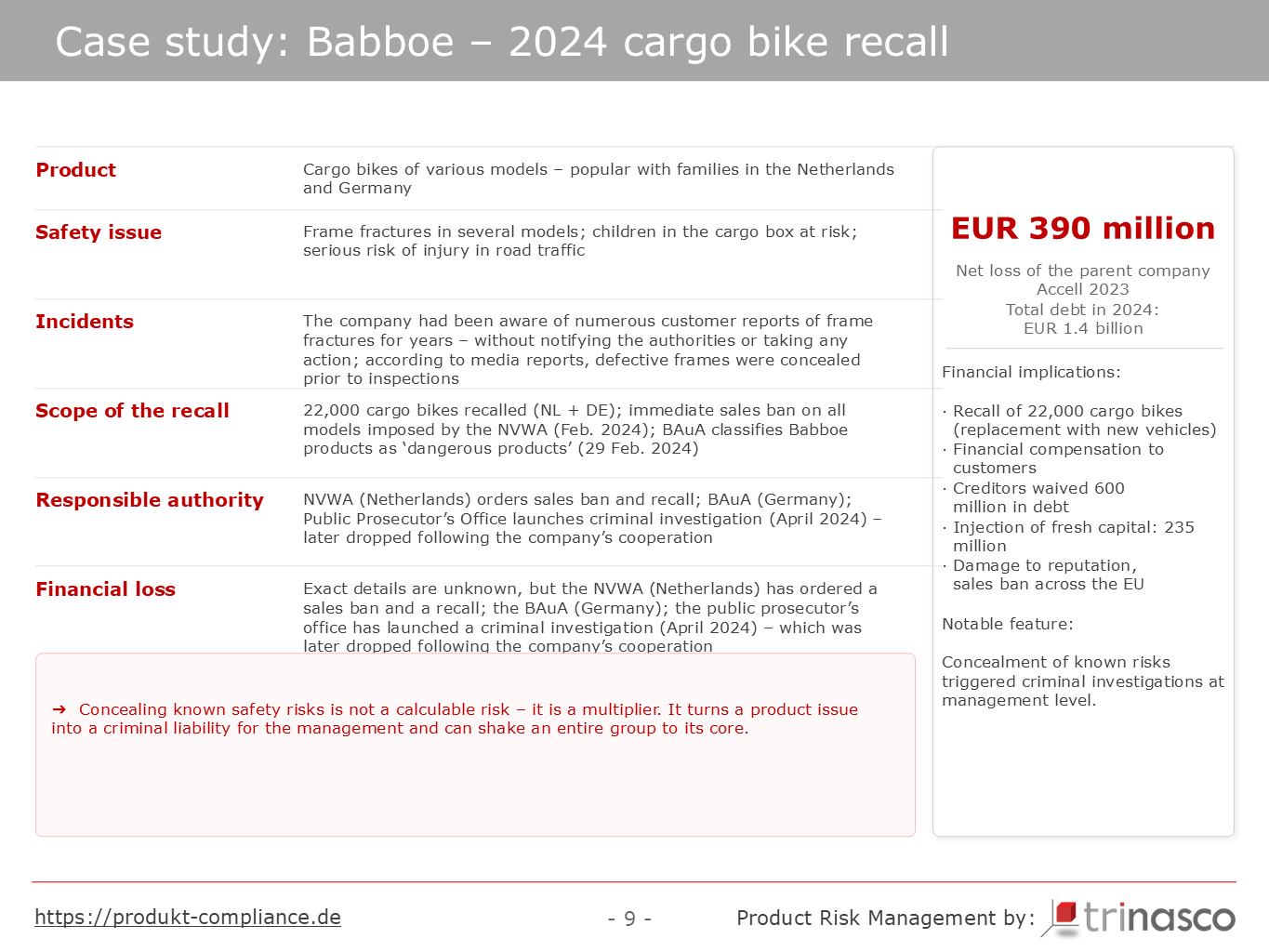
The Babboe case is the most recent and structurally most instructive example. The Dutch cargo bike manufacturer — known for affordable family cargo bikes, widely used in Germany and the Netherlands — had received numerous customer reports of frame fractures over the years. The legally required notification to the competent authority and a systematic root cause analysis were not carried out. According to media reports, defective frames were also allegedly hidden before regulatory inspections.
In February 2024, the Dutch authority NVWA (Nederlandse Voedsel- en Warenautoriteit) ordered an immediate sales ban on all Babboe models and required the company to recall affected bikes. In Germany, the BAuA classified most Babboe cargo bikes as “dangerous products” with effect from 29 February 2024. In April 2024, the Dutch public prosecutor initiated criminal proceedings against the company — on suspicion of systematically concealing safety risks and deceiving the authorities. The proceedings were subsequently dropped after the company cooperated and the prosecutor opted for administrative law measures.
In total, around 22,000 cargo bikes were recalled; customers received replacement bikes or financial compensation. Parent company Accell recorded a net loss of €390 million in 2023 — the year before the scandal became public — on a revenue decline of ten per cent. The full financial damage from the Babboe recall is not separately disclosed. In the course of the group restructuring, Accell and its creditors (banks and bondholders) agreed a debt waiver: of the original €1.4 billion in debt, €600 million was written off — the remaining €800 million in liabilities continues to be serviced. Additionally, €235 million in fresh capital was injected into the group.
What this case particularly illustrates: concealing known safety risks is not a minor offence. It does not merely trigger recall costs — it creates criminal prosecution pressure at management level, destroys the trust of customers and trading partners, and can — as in the Babboe case — shake an entire corporate group to its foundations.
Back to fines — and to the only compliance area in which concrete case figures and loss amounts are publicly documented: packaging law.
The ZSVR (Central Packaging Register Office) publishes case reports. What they contain is instructive:
One large food company had failed to submit completeness declarations for four years. The result: a legally confirmed fine of €35,750 — plus retrospective system participation costs and an entry in publicly accessible case reports.
In another documented case — a foreign mail-order pharmacy — the retrospective system participation costs alone for five years of missing participation amounted to at least €2 million. On top of this came possible fines of up to €200,000 per individual violation, profit skimming by the regional authority and a de facto distribution ban until the violations were remedied.
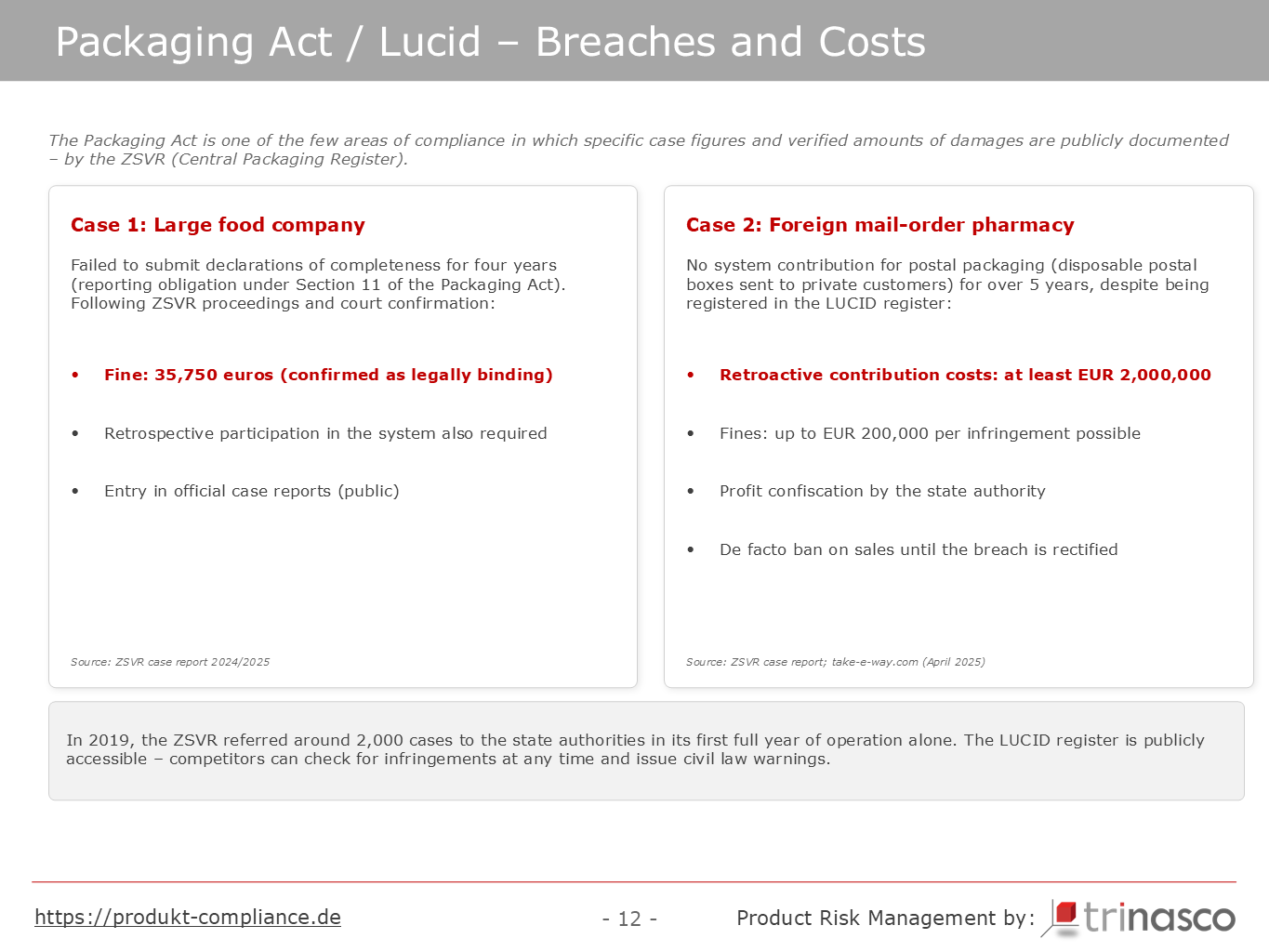
What makes this example particularly relevant: the LUCID register is publicly accessible. Competitors can check for violations at any time and issue cease-and-desist letters under competition law. Non-compliance in packaging law is therefore not purely a regulatory risk — it is a civil law risk vis-à-vis the entire competitive environment.
And packaging law will become considerably more complex and demanding in the coming years through the EU Packaging Regulation PPWR (Regulation (EU) 2025/40) — with corresponding risk potential.
The figures presented in this article are not outliers. They are documented cases from various product categories — toys, kitchen appliances, fitness equipment, packaging. Companies that market their products in Europe operate within exactly this risk profile.
The central argument of those who oppose compliance — “compliance costs money and achieves nothing” — collapses as soon as the other side of the equation is considered. The correct question is not: “What does compliance cost?” The correct question is: “What does non-compliance cost — and what is the ratio between these costs?”
The answer: with a recall that costs on average six figures even in the non-food consumer goods sector, and with realistic profit margins of 5 to 15%, a single significant recall is enough to justify many years of compliance expenditure. And that calculation does not yet include reputational damage, market share losses or long-term consequences.
What this means in practice:
trinasco advises companies that market consumer goods in Europe on the operational implementation of product compliance requirements. This covers the analysis and assessment of compliance risks at product and assortment level, the development of processes, the training of staff, supplier communication and development, and the introduction of suitable software solutions.
For companies that cannot or do not wish to build compliance in-house, trinasco acts as an outsourced product compliance department, taking over operational activities in full — from ongoing monitoring of requirements through document management to regulatory communications.
Anyone wishing to find out what their own risk profile looks like and where the biggest gaps lie is welcome to contact us:
Free initial assessment of your compliance structure
trinasco offers a free initial assessment of your compliance situation — without obligation. Contact us: www.produkt-compliance.de
What do you need to do now? Book our free initial consultation now.
Save €249!!

What do you need to do now? Book our free initial consultation now.
Save €249!!











Bei den Mühren 1
20457 Hamburg
040 46 86 80 00
Some images on this website were created using AI image generation and serve as illustrative representations of our services.