


An analysis based on ten current consumer studies
Three contradictions this article explains:
① Only 8% of consumers actively think about product safety when buying – yet 84% take it for granted unconditionally. How can a topic be so unimportant and so decisive at the same time?
② Sustainability ranks only 6th among purchasing factors in the EU Eurobarometer. At the same time, companies invest millions in green claims. Who is getting it wrong?
③ 91% of Gen Z say they prefer to buy from sustainable brands. In the store, most still reach for the cheaper product. What does that mean for your communication strategy?
Product safety and sustainability are among the most discussed topics in corporate communication. But what do consumers actually think about them – and what role do these factors really play when they make a purchasing decision? These questions are more relevant for companies today than ever: anyone developing product, communication and sales strategies needs a realistic picture of the expectations consumers bring with them – and how these differ from what is often claimed in public debate.
Current studies – from the European Commission, the UK Office for Product Safety and Standards (OPSS), TÜV SÜD and international consultancies – paint a nuanced picture. Most consumers expect product safety as a self-evident basic requirement. Sustainability and environmental protection are gaining significant weight – especially among younger target groups – without this automatically translating into a willingness to pay more. And the communication of both topics has been subject to stricter legal requirements since 2026.
Product safety is rarely surveyed directly in consumer research – and when it is, the results paint a surprising picture. The TÜV SÜD Safety Gauge, to date the most extensive international study series on purchasing factors for non-food consumer goods (toys, electronics, textiles, footwear), documents a striking development over almost ten years.
In 2007, 47 percent of the consumers surveyed rated product safety as very important – as a purchasing factor it then ranked 4th, behind price, quality and brand. By 2016 the picture had changed fundamentally: safety had become the most frequently cited purchasing factor – ahead of price and functionality. 60 percent of respondents worldwide now rated safety as very important.
In Germany this effect was particularly pronounced: 71 percent of German consumers said they were willing to pay a higher price for demonstrably safer products – for children’s products this figure even rose to 80 percent. This is a strategically relevant finding: product safety is not an abstract compliance topic but a potential differentiating factor with a measurable willingness to pay.
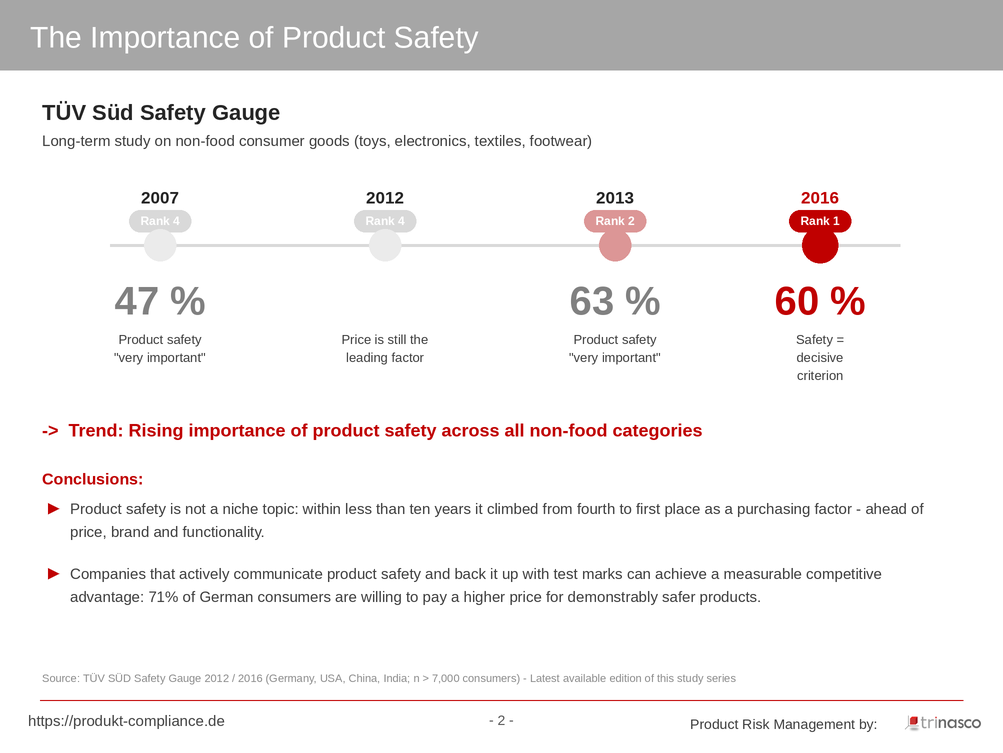
What explains this change? The study’s authors point to the influence of several parallel developments: greater media presence of product recalls, growing awareness of health risks from contaminated materials and – not least – the expansion of online retail. Consumers who can no longer physically inspect products look for other safety signals. Test marks, certifications and country of origin became orientation markers.
71 percent of German consumers are willing to pay more for demonstrably safer products. For children’s products this figure rises to 80 percent. – TÜV SÜD Safety Gauge 2016
An apparent contradiction emerges when you ask about the active importance of product safety at the moment of purchase. The UK Office for Product Safety and Standards (OPSS) has been conducting an ongoing longitudinal study since 2019, in which several thousand consumers are regularly surveyed about their behaviour when buying household appliances, electrical products, toys, baby products and cosmetics. The results from Wave 4 to 8 (2023–2024) show a consistent pattern:
Only 8 percent of respondents spontaneously name product safety as a purchasing factor – and yet 84 percent expect a product to be safe regardless of price. Just 17 percent actively consider safety when buying, while 100 percent simply take it for granted. From a business perspective this is an important insight: product safety functions as a hygiene factor.
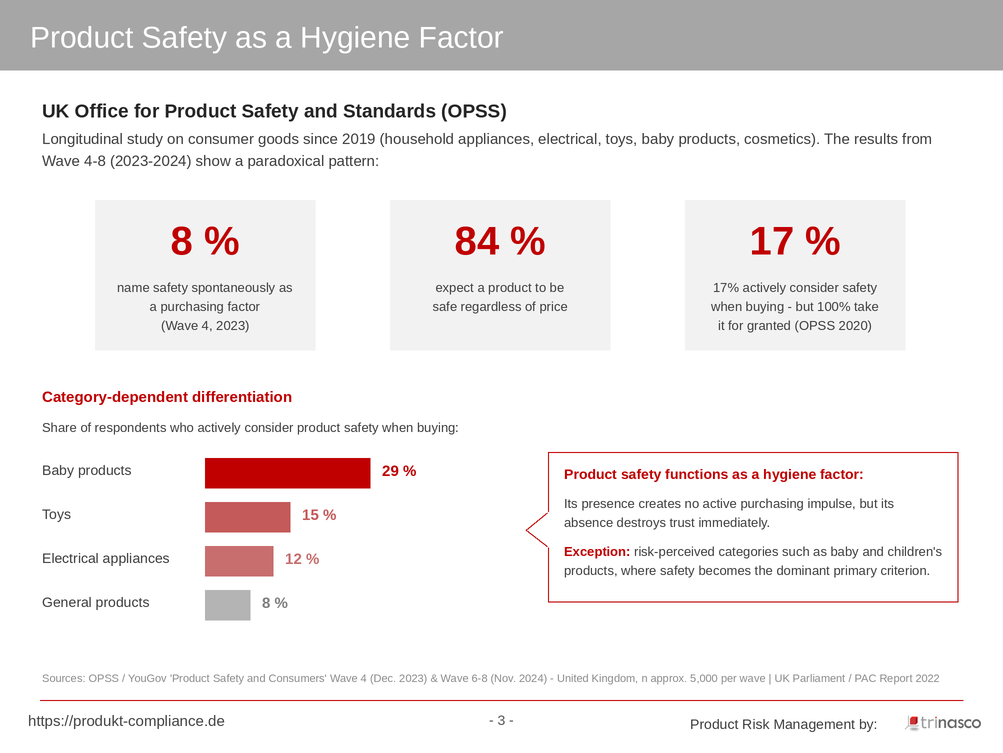
Its presence creates no active purchasing impulse – its absence, however, destroys trust immediately and lastingly. As soon as safety defects become known – through recalls, media reports or regulatory action – consumers and the public react immediately.
Note: The exception proves the rule: for baby products the share of active safety considerations rises to 29 percent, for toys to 15 percent. In categories perceived as high-risk, product safety becomes the primary purchasing criterion – and should be communicated accordingly.
The EU Consumer Conditions Scoreboard 2025 (European Commission / IPSOS, November 2024, EU27 + Norway + Iceland) confirms a high level of basic trust: 68 percent of EU consumers say they trust the safety of the products they buy. At the same time, 61 percent trust public institutions as protective authorities.
This trust is not a naive attitude – it is the result of decades of regulation, functioning market surveillance and clear standardisation requirements. For companies this means: their customers’ trust is not self-earned but systemically borrowed. Anyone who wants to use it must actively meet the conditions for it.
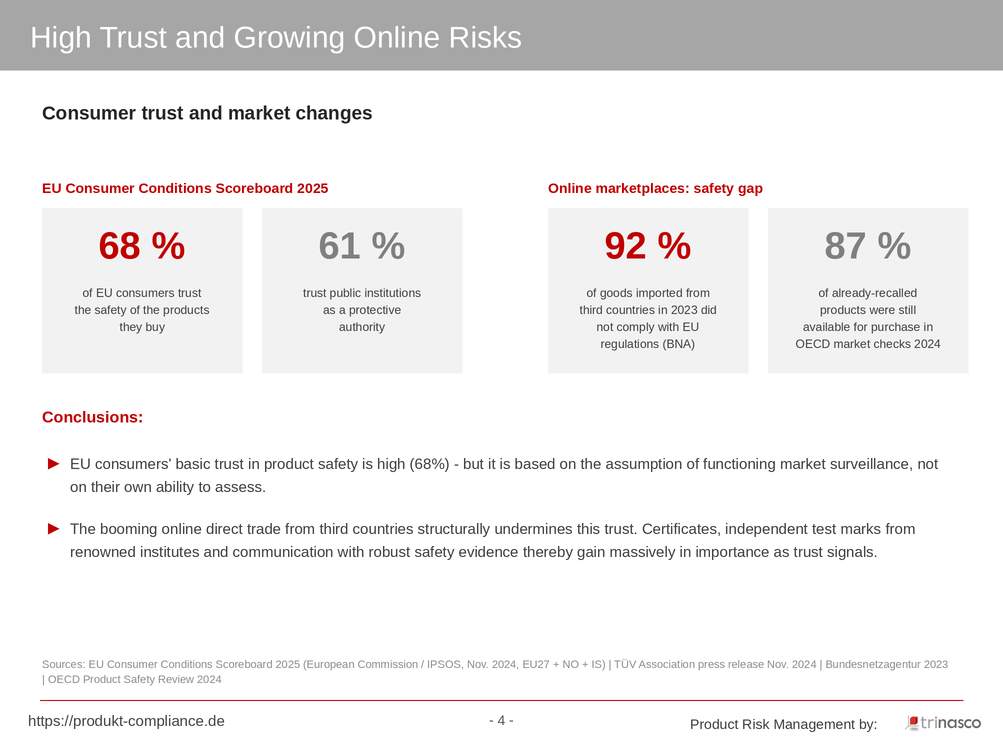
In the context of growing online direct sales from third countries, this systemic trust has come under pressure: 92 percent of the consignments from third countries inspected by the Bundesnetzagentur in 2023 did not comply with EU regulations; according to the OECD, 87 percent of products already recalled were still available on online platforms. Companies that ensure compliance gain a measurable trust advantage over non-compliant providers through transparency and documented evidence.
92% of inspected consignments from third countries did not comply with EU regulations in 2023. – Bundesnetzagentur 2023
Sustainability is one of the most discussed topics in corporate communication. All the more important, then, is a sober look at what consumer studies actually prove – beyond wishful thinking and media exaggeration.
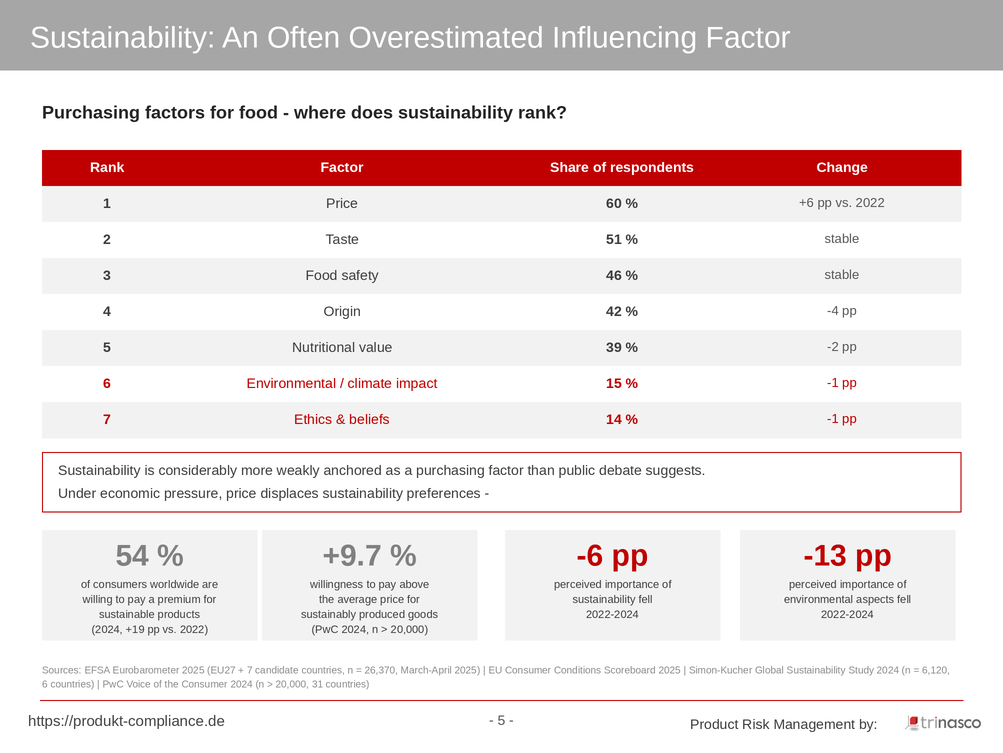
The EFSA Eurobarometer 2025 shows for everyday consumption: price (60%), quality and sensory properties dominate the purchasing decision. Environmental and climate impact comes in 6th place at 15 percent. The EU Consumer Conditions Scoreboard 2025 also shows that the share of consumers who actively consider environmental aspects when buying fell by 13 percentage points between 2022 and 2024 – to 43 percent. The Simon-Kucher Global Sustainability Study 2024 confirms this decline and attributes it to inflation and economic pressure.
So why do companies still invest millions in green claims? Part of the answer lies in willingness to pay: 54 percent of consumers worldwide say they want to spend more on sustainable products (Simon-Kucher 2024, +19 pp. compared with 2022).
The PwC Voice of the Consumer Survey (2024) puts this willingness to pay a premium at an average of 9.7 percent. What consumers are willing to pay and what they actually do at the moment of purchase, however, regularly diverge – a well-known phenomenon in consumer psychology that is particularly pronounced for sustainability topics.
An important strategic distinction concerns generational differences. Current research shows a consistent picture: Gen Z and Millennials attach considerably more weight to sustainability and environmental aspects than older age groups.
According to a study by PDI Technologies (2023), 91 percent of Gen Z consumers prefer brands that commit to sustainability; 77 percent are willing to pay more for it. An international e-commerce study shows that 94 percent of Gen Z and 93 percent of Millennials consider sustainability aspects when buying – compared with 77 percent among Baby Boomers.
However, the same applies here: willingness to pay and actual purchasing behaviour diverge, especially when the economic burden is high. European studies – such as the Youth Pulse survey by Opeepl (2024, n = 2,500, France / Germany / Italy / Spain / UK) – show that sustainable consumption ranks only 9th among the most important topics for Gen Z; just 18 percent actively look for sustainable products when shopping.
Conclusion: For younger target groups, sustainability is a baseline expectation of brands and companies – not a purchasing driver in the classic sense, but a relevant reputation and loyalty factor that should be strategically considered in product development, range policy and brand communication.
When communicating product safety, sustainability and environmental properties, companies face a specific legal challenge: many of these properties are legally required – CE marking, compliance with pollutant limits, energy efficiency classes. Advertising the mere existence of such minimum regulatory standards is not only communicatively delicate but generally prohibited under competition law.
The reason lies in Annex No. 10 to Section 3 (3) UWG (German Act Against Unfair Competition): making an untrue statement or creating the inaccurate impression that legally existing rights constitute a special feature of the offer is a so-called per-se infringement – i.e. inadmissible without further ado, regardless of whether consumers are actually deceived. The Federal Court of Justice (BGH) most recently expressly confirmed this principle in July 2024 (case no. I ZR 164/23): advertising with self-evident facts is unfair, even if the statement is objectively correct and even if it is not particularly emphasised.
In concrete terms this means: anyone who advertises the CE marking as if it were a quality feature or a voluntary service violates Section 5 UWG. In this context the Higher Regional Court (OLG) pointed to the particularly high risk of deception with the CE mark, because its actual meaning – a manufacturer’s self-declaration of legal conformity, not an independent test – is largely unclear among consumers.
A further example concerns electrical appliances: the RoHS Directive (2011/65/EU, implemented in Germany by the ElektroStoffV) has been subject to CE marking since 2013 – RoHS conformity is therefore a legal prerequisite for the CE marking of electrical products, not an optional feature. A separate RoHS symbol or the note ‘RoHS-compliant’ on packaging falsely suggests a special achievement to the consumer and is challengeable under competition law.
On top of this, since March 2024 there are the stricter requirements of the EmpCo Directive (EU) 2024/825. The EmpCo Directive came into force in March 2024 and had to be transposed into national law by the member states by 27 March 2026.
Germany did this through the Third Act Amending the UWG, which was promulgated in the Federal Law Gazette on 19 February 2026 (BGBl. 2026 I No. 43). The new rules are binding on all companies from 27 September 2026. From then on, the following are prohibited:
New transparency obligations concern durability, repairability and software updates – topics directly linked to sustainable product development.
For companies, a clear consequence follows from this: communication must become more precise, more substance-based and more legally secure. Anyone who can actually substantiate the sustainability and safety properties of their products communicates at a level that competitors without corresponding substance cannot reach. Credibility becomes a differentiating feature.
With EmpCo, sustainability communication is not banned but grows up. Companies may continue to talk about environmental performance – if they can substantiate it concretely.
The body of studies allows several strategically robust conclusions:
The implicit trust that consumers extend to brick-and-mortar retail does not automatically transfer to the online environment. Anyone selling products through digital channels must make product safety and compliance explicitly visible: through robust information, independent certifications and traceable documentation.
Product safety does not have a uniform importance. In categories perceived as high-risk – baby products, toys, electrical appliances – it is the primary purchasing criterion. Here, explicit communication backed by independent testing pays off. In other categories it is enough to meet the basic requirements and to demonstrate them transparently when needed.
Sustainability is not a universal purchasing driver – but for younger target groups it is a reputation and loyalty factor. Companies targeting Gen Z and Millennials should communicate sustainability aspects in a visible, specific and verifiable way – not as a marketing promise but as a substantiated product property. For older target groups: quality, price and reliability dominate.
The stricter requirements of the EmpCo Directive should be understood not as a burden but as a strategic opportunity: anyone who puts environmental and sustainability claims on a substantial footing now will be better positioned from September 2026 than competitors who have to adjust their communication after the fact. A systematic inventory of all existing environmental claims – coordinated between product management, the legal department and communication – is the basis for this.
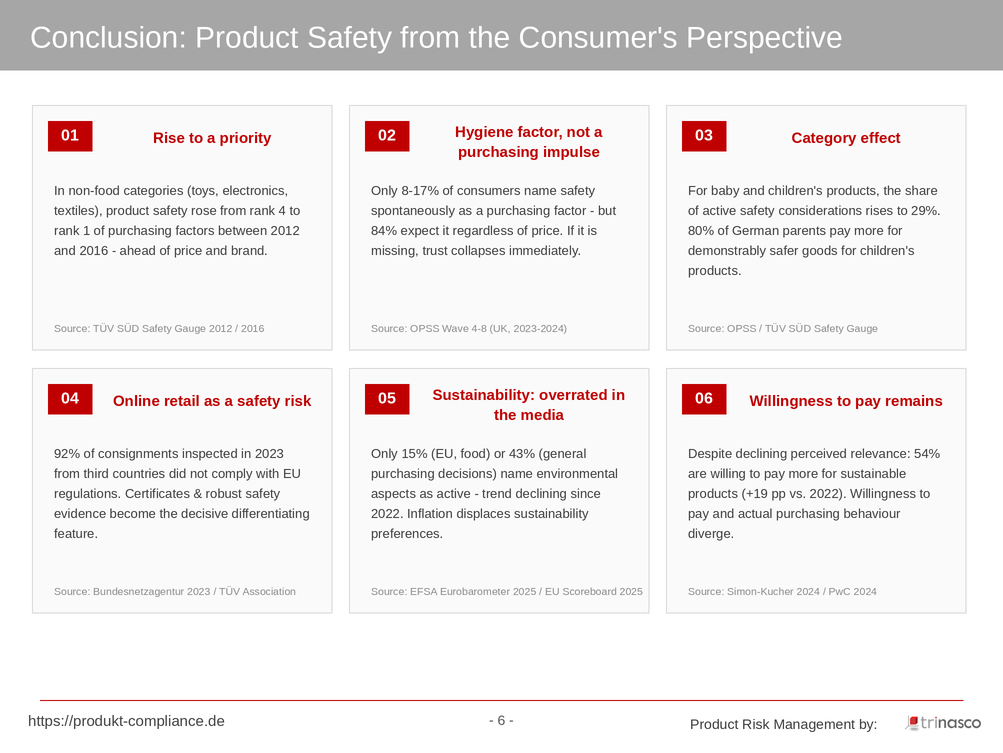
For European consumers, product safety and sustainability are not marginal factors – but neither are they dominant purchasing decision-makers in the classic sense. They are baseline expectations: taken for granted, rarely actively assessed, but noticed immediately when they are missing. Younger generations are moreover developing an increasingly values-based attitude, in which sustainability and environmental responsibility become a baseline expectation of brands – even if this does not always translate into a willingness to pay more at the moment of purchase.
For companies, a clear message follows from this: anyone who treats product safety and sustainability as a self-evident compliance duty and keeps them in the communicative background is giving away potential. Anyone who integrates them into strategy and communication in a substance-based, category-specific and audience-appropriate way builds trust – and turns regulatory requirements into a measurable competitive advantage.
Consumer research provides the basis for this. It is up to companies to use it.
What do you need to do now? Book our free initial consultation now.
Save €249!!

What do you need to do now? Book our free initial consultation now.
Save €249!!



Bei den Mühren 1
20457 Hamburg
040 46 86 80 00
Some images on this website were created using AI image generation and serve as illustrative representations of our services.