


An overview of standards, registry in trial operation and the timetable since 20 July 2026 – and what this means in concrete terms for textiles, iron & steel, furniture and other sectors
The Digital Product Passport (DPP) reached a significant milestone in its implementation in summer 2026: six out of eight technical standards have been published, whilst the remaining two have undergone formal approval. Furthermore, since 20 July 2026, the European Commission’s central DPP registry has been in trial operation – complete with a test environment, a user manual and a web interface through which companies can already register.
This means that the Digital Product Passport is no longer an abstract sustainability promise, but a system comprising standards, a central registration body and a timetable with the first binding deadlines from February 2027. What is relevant for companies is that the standardisation work is largely complete, and the transition periods following the adoption of a legal act are short.
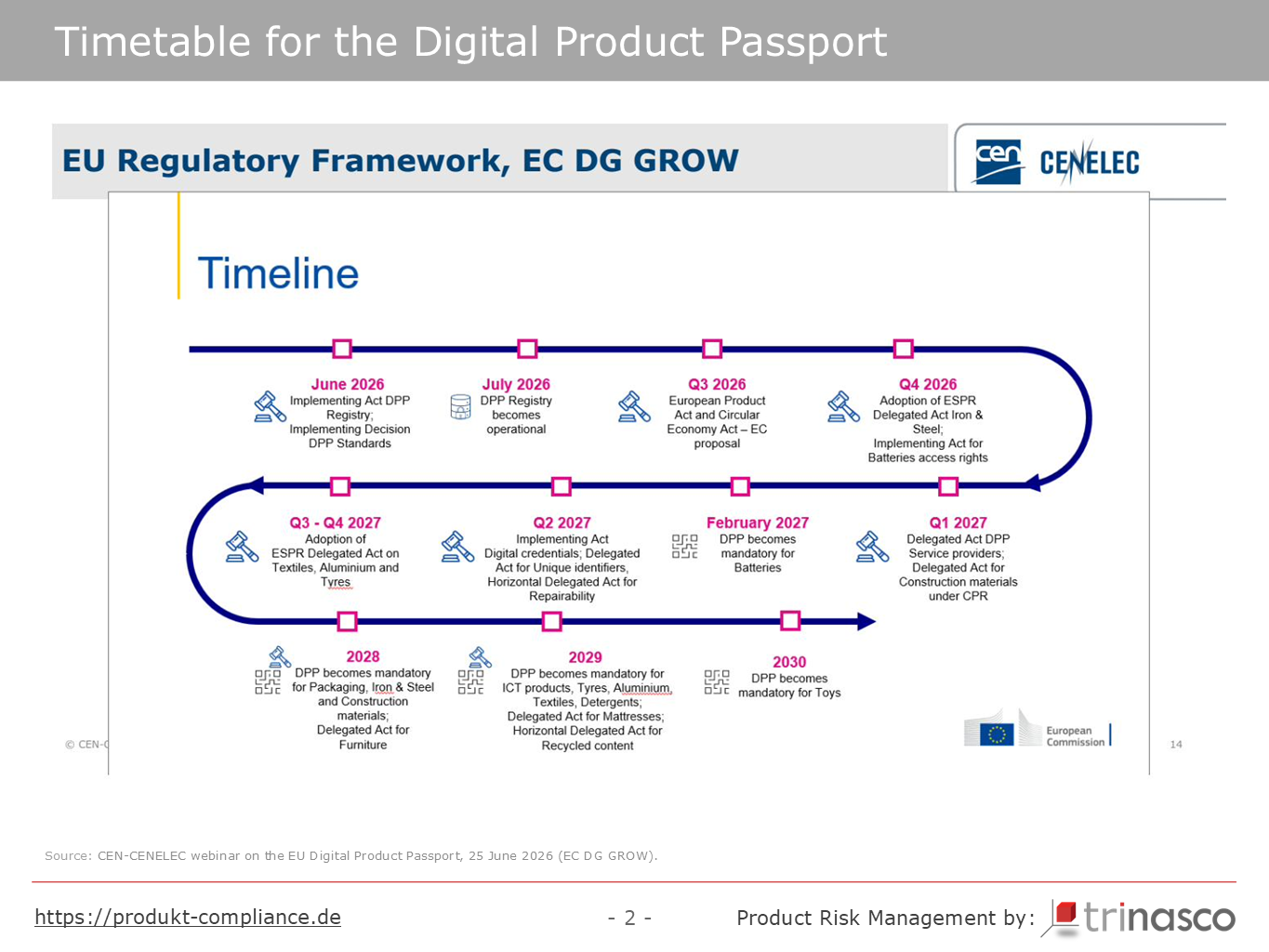
This article outlines the current status – the legal basis, the package of standards, the new registry, and the sector-specific roadmap for five product groups that will be affected first.
The legal basis for the Digital Product Passport is the Ecodesign Regulation for Sustainable Products (ESPR). However, the ESPR itself does not contain any product-specific obligations – these are being introduced gradually via so-called delegated acts, each covering individual product groups.
To ensure that these legal acts do not have to start from scratch from a technical perspective each time, the European Commission, through standardisation request M/604 (and its amendment M/604_Amd1), commissioned the joint technical committee CEN-CLC/JTC 24 ‘Digital Product Passport – Framework and System’ to develop a horizontal set of technical standards covering all product groups. The result: eight modular, interlinked standards, drawn up by over 300 experts from 34 countries – in a development period of around 18 months. For a regulatory framework of this scope, that is a remarkable pace.
The path for such a standard to have a genuine impact involves four steps: the European Commission issues the standardisation mandate; the relevant body – in this case, JTC 24 – draws up the standard; the Commission checks whether the standard meets the requirements of the underlying regulation; and only upon publication in the Official Journal of the European Union (OJEU) does a so-called ‘presumption of conformity’ arise. Over 4,000 harmonised standards are already listed in the Official Journal in this way – the DPP set of standards is one of many such standardisation mandates, but one of the most comprehensive in recent years.
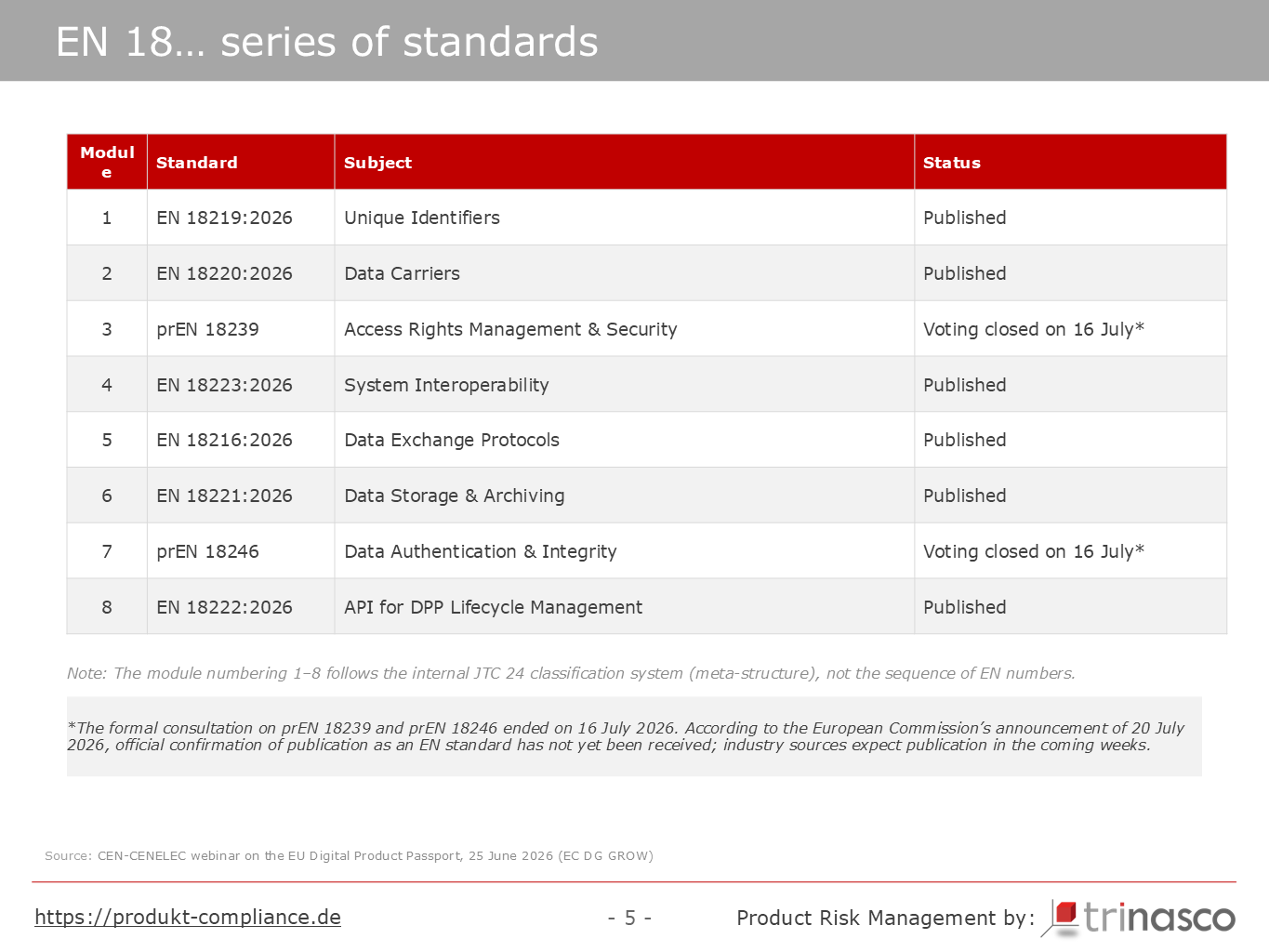
Each of the eight standards in the EN 18xxx series addresses a specific sub-issue – ranging from unique identification and data carriers to access security. Six have already been published (EN 18216, 18219, 18220, 18221, 18222, 18223); for the two remaining standards (prEN 18239, prEN 18246), the formal voting process concluded on 16 July 2026 – according to an EU Commission announcement dated 20 July 2026, official confirmation of their publication as EN standards had not yet been issued, though industry sources expect this to happen in the coming weeks.
Six of these eight standards can be directly linked to seven specific operational tasks that economic operators must carry out: creating a unique identifier, attaching a data carrier, storing data, backing up this data, registering the passport, managing access rights and ensuring data integrity. The remaining two standards are to be understood as more overarching in nature, rather than being tied to a single procedural step.
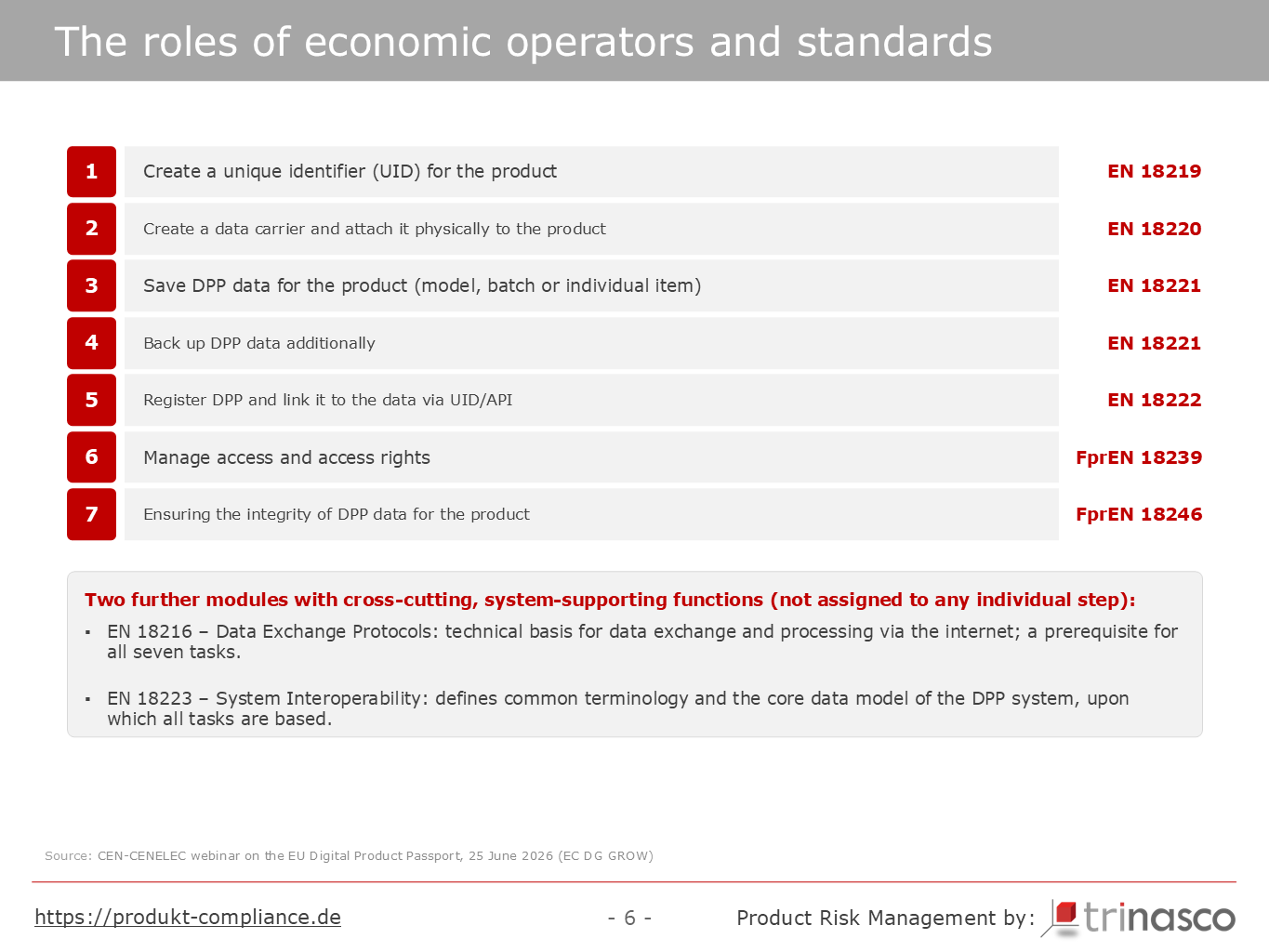
For a quick overview, the eight standards can be divided into three groups:
This breakdown highlights just how extensive the technical standardisation behind the scenes actually is: only two of the eight standards relate to what is obvious and tangible for a company – identification and data carriers. The remaining six standards ensure that the system, comprising millions of individual product passports, functions reliably and remains secure across Europe. This is also the reason why the development of all eight standards – despite the considerable pace – took around 18 months.
For most companies, this raises a key, very practical question: do I need to create a separate digital product passport for every single item sold – or is one passport sufficient for an entire production batch, a product model or even an entire product group? The answer to this question determines whether the DPP will be a manageable additional burden or a massive disruption to production, logistics and IT.
It is precisely this question that is addressed by one of the eight standards – though not exhaustively, but only in broad terms: two of the eight standards therefore merit closer scrutiny, as they demonstrate just how much the horizontal standards deliberately leave open – and why the actual answer will only come with the product-specific delegated act.
EN 18219 defines three possible levels of granularity for unique identifiers: model (one identifier per product model), batch (one identifier per production batch) and individual item (one identifier per item). The standard does not mandatorily prescribe any of these levels – it supports the level required by legislation, product category and use case. In the case of batteries, for example, the Batteries Regulation will require, from February 2027, a passport for each individual unit of electric vehicle, LMT and industrial batteries exceeding 2 kWh – in addition to the model and batch identification on the product itself.
Similarly, EN 18220 defines five possible data carrier technologies: QR code, DataMatrix, NFC, HF-RFID and RAIN-RFID (UHF). Here too, the standard specifies the technical requirements but does not prescribe which technology will be mandatory for which product group. It is important to note that not every RFID technology is equally usable for the end customer. HF RFID (13.56 MHz) can be read using standard smartphones, whereas UHF RFID (860–960 MHz) cannot – a specialised reader is required for this.
A well-known real-world example: the sports retailer Decathlon already uses UHF RFID tags extensively for its own logistics – however, these tags are not machine-readable for end customers. UHF RFID is therefore not suitable for consumer-facing DPP access; at best, it could be used as a parallel medium alongside a separate QR code for retail and logistics purposes.
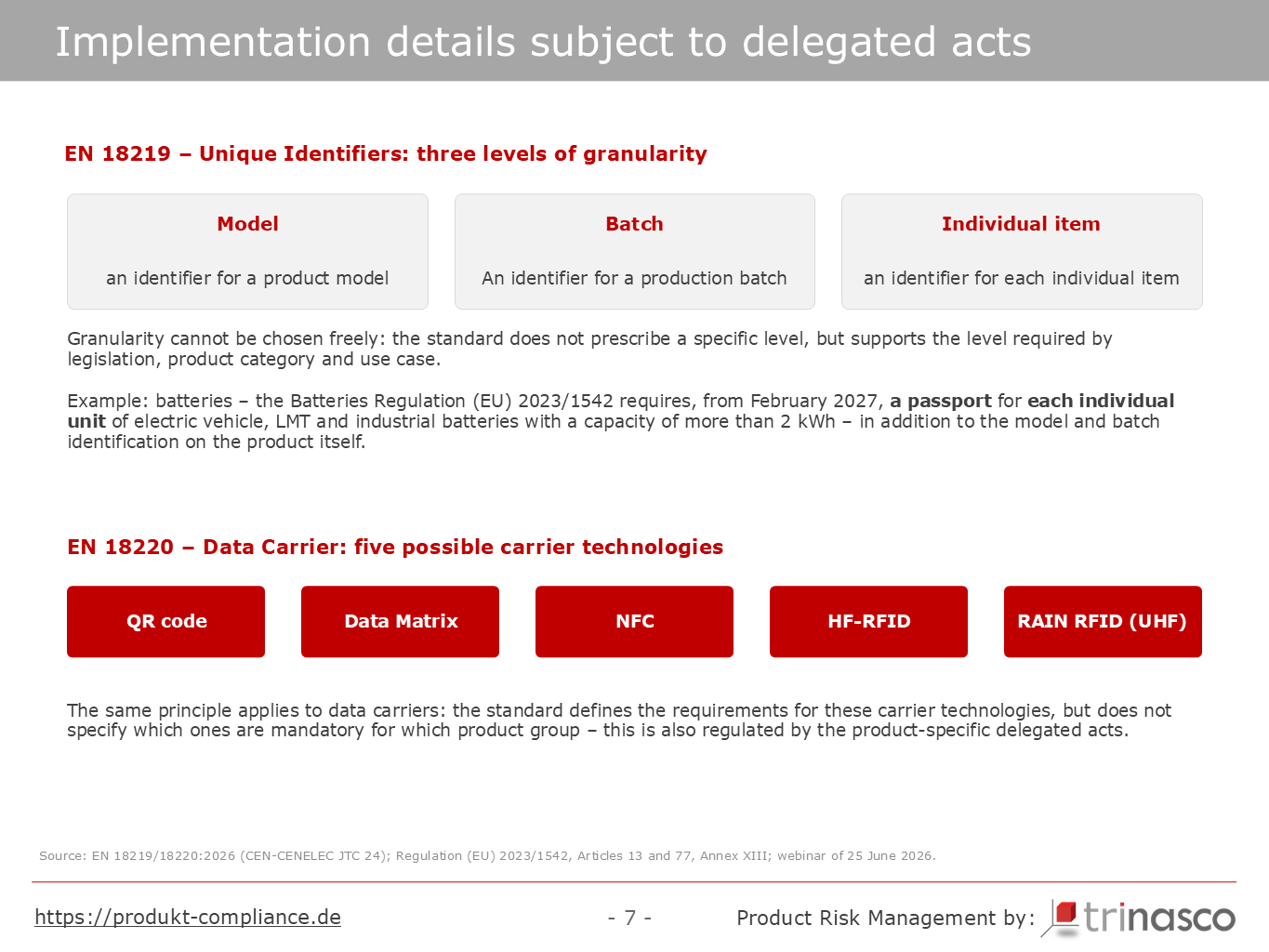
The crucial point in practice is that neither the level of granularity – individual item, batch, model or product group – nor the data carrier technology is clearly defined in any of the eight horizontal standards. Both are only bindingly determined by the relevant product-specific delegated act – which may be similar for several product groups. Anyone who makes their own decision on technology or granularity now, without waiting for the relevant legal act, risks planning in a way that fails to comply with future requirements.
The second major component, alongside the standards, is the European Commission’s central DPP registry – live since 20 July 2026, including a test environment and a user manual for economic operators. The following overview sets out the key points:
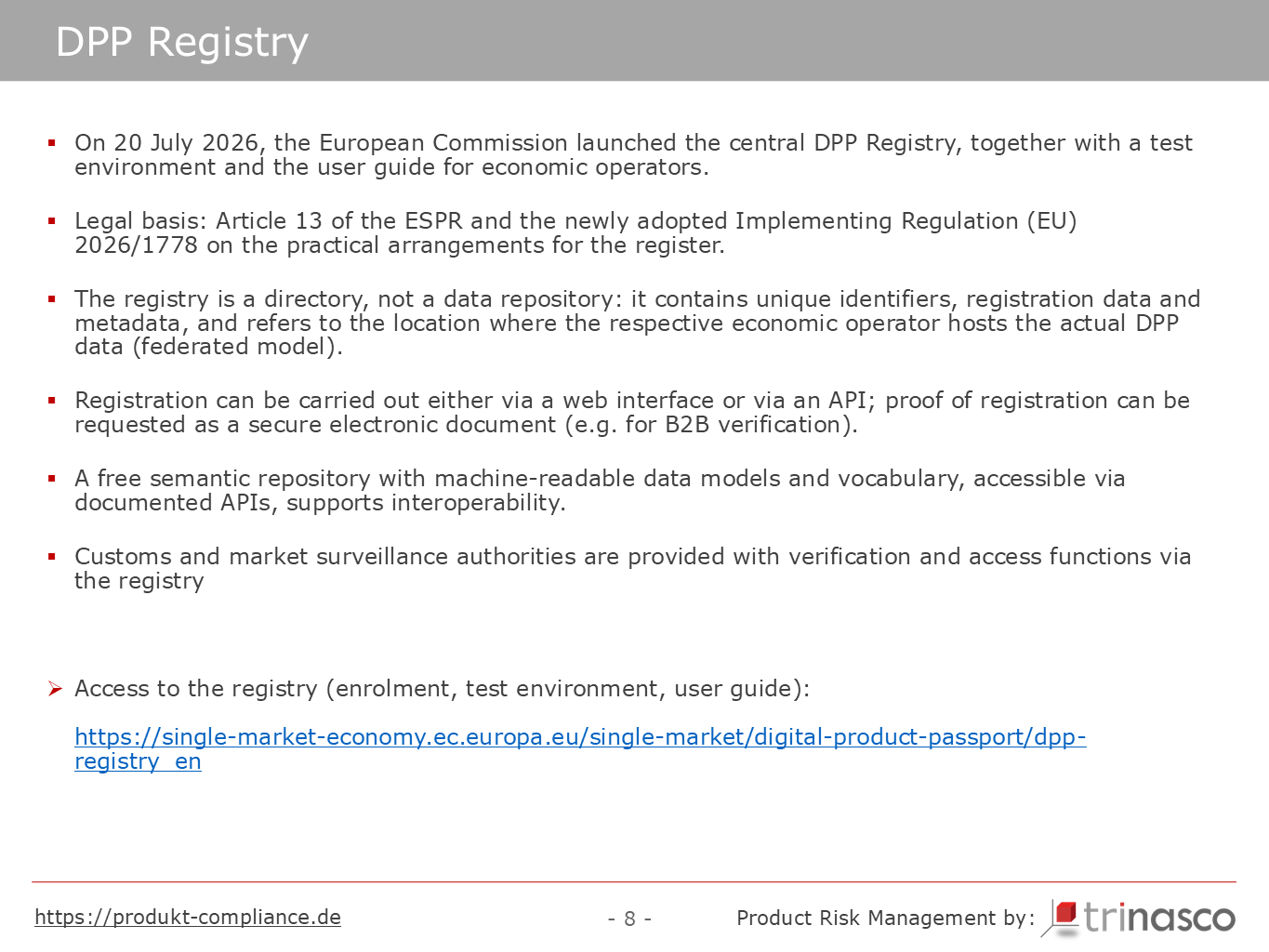
In practical terms, this means:
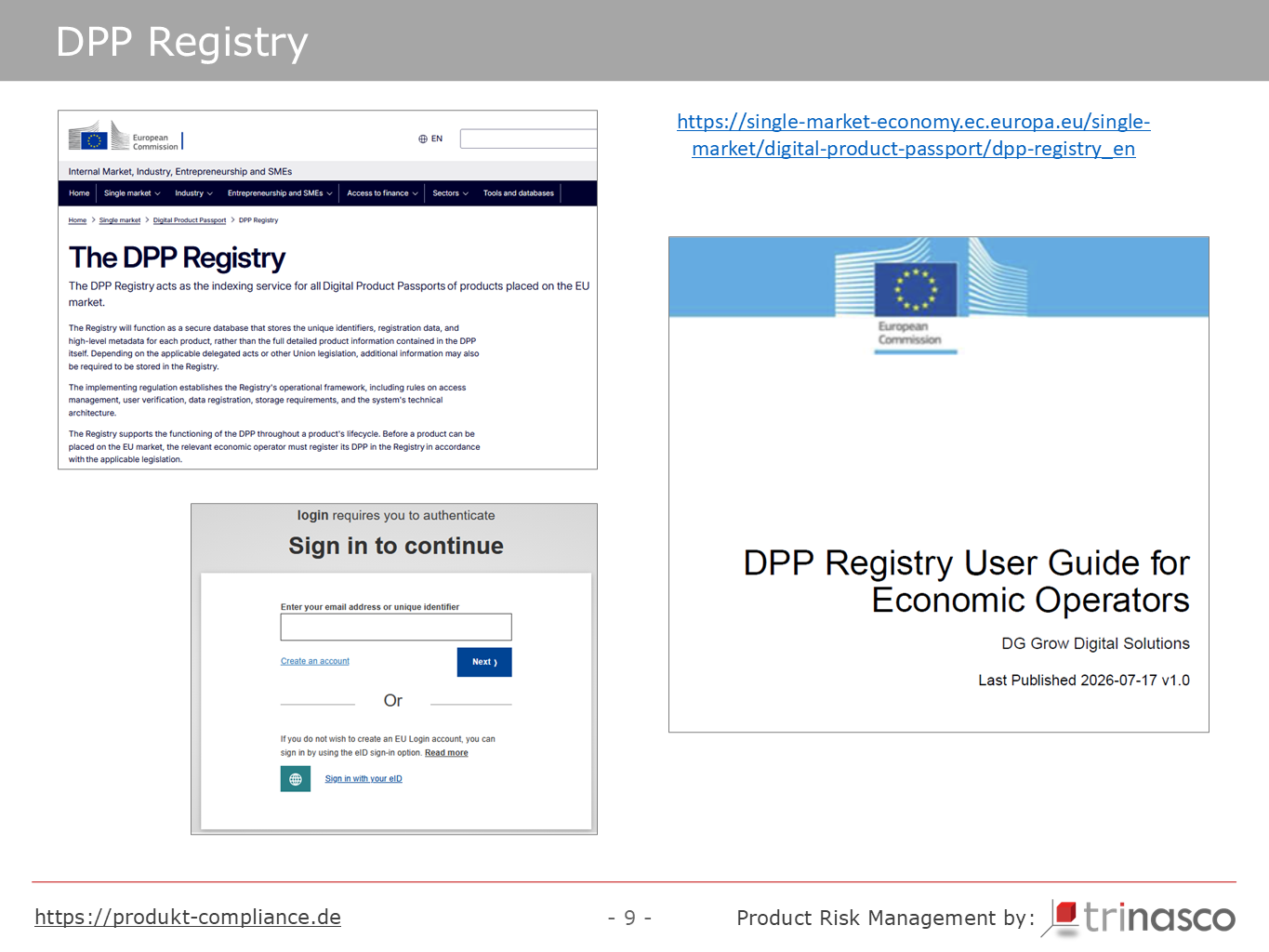
Access to the registry – including enrolment, the test environment and the user guide – is available at: single-market-economy.ec.europa.eu/single-market/digital-product-passport/dpp-registry_en. Anyone who familiarises themselves with the test environment now will gain a significant head start when the first product groups actually become mandatory from 2027.
As uniform as the horizontal standards package is, the status within the individual product groups varies considerably. We have examined five prioritised sectors – from the most advanced to the least concrete:
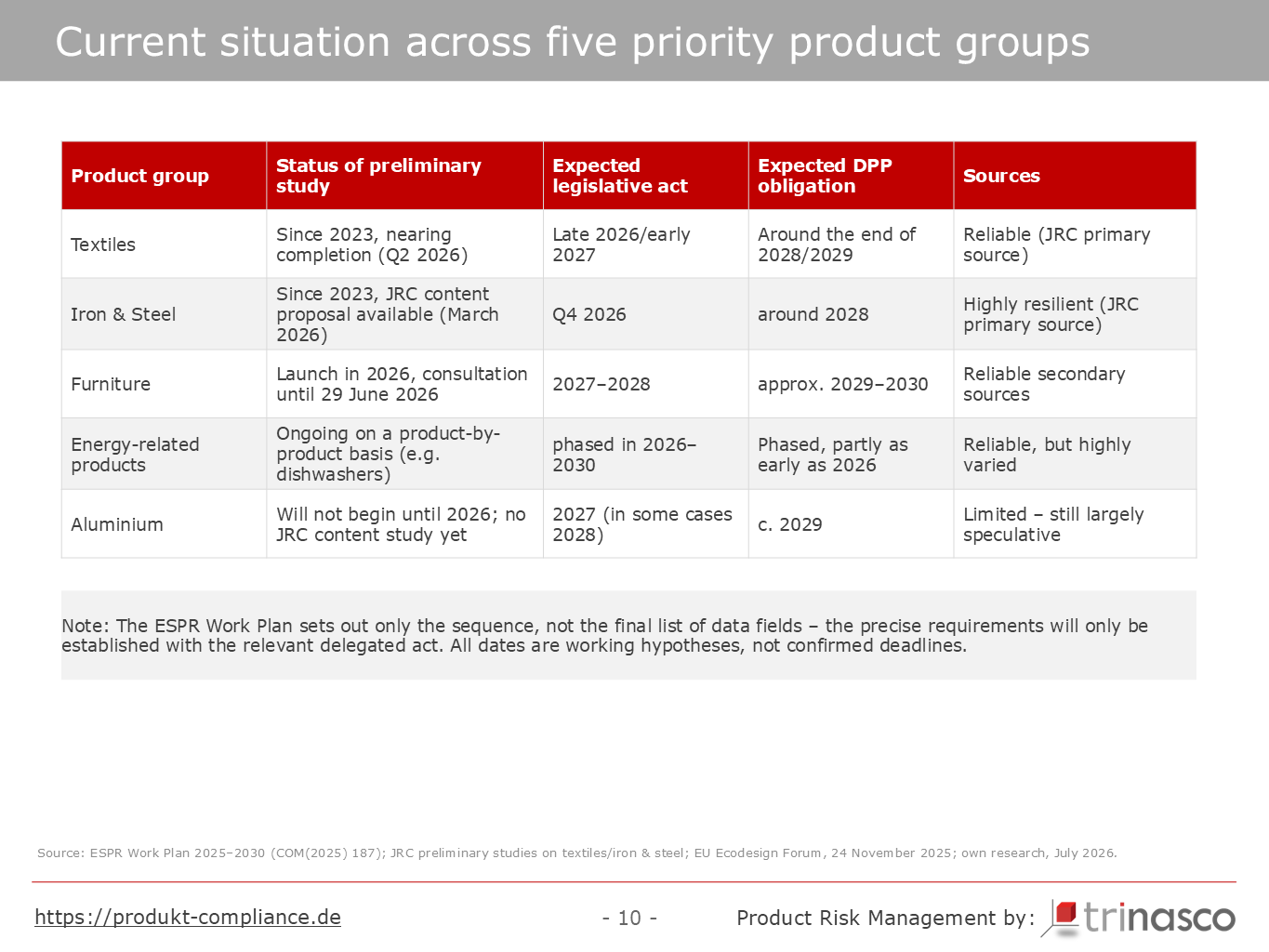
Important to note: The ESPR work plan only sets out the order, not the final list of data fields. The exact requirements will only be established with the respective delegated act – all dates are working hypotheses, not confirmed deadlines.
In the textiles sector, the preliminary study at the JRC (Joint Research Centre, the scientific service of the European Commission) is the most advanced: the third milestone report was presented in January 2026, and the consultation ran until March 2026. The delegated act is widely expected by the end of 2026/early 2027 – following its adoption, the standard transition period of at least 18 months for delegated acts is likely to apply before it becomes binding, meaning that the DPP obligation can realistically be expected to come into force from the end of 2028/2029.
The focus is on finished clothing products (knitted goods, denim, other woven goods). As things stand, intermediate products, smart textiles, personal protective equipment, medical devices and textile clothing classified as toys are excluded. With regard to performance and information requirements, there are indications of a link to the Product Environmental Footprint Category Rules (PEFCR), repairability approaches, recyclability scores, information on material composition and the proportion of recycled content, as well as substances of concern.
Of particular practical relevance: as already explained, only QR codes/DataMatrix and NFC (HF-RFID) are suitable for end-user access, as UHF-RFID – despite its widespread use in retail logistics – cannot be read by standard smartphones. The most likely standard scenario is a sewn-in or printed QR label.
In terms of granularity, the batch appears to be the likely minimum level of detail – particularly for manufacturer and plant data – whilst most product characteristics remain at the model level. This ties in well with existing practice: in textile production, certification, quality control and traceability, batch information is already widely recorded. Unlike an immediate obligation to label individual items, this would not represent a break with existing practice.
For iron and steel, the most detailed primary source by far is now available: a JRC report published in March 2026 specifically addressing the DPP content requirements for steel products. Important: Only intermediate products are explicitly covered – hot-rolled strip, wire rod, galvanised cold-rolled strip, electrical steel and stainless steel – not the end products manufactured from them in the automotive, construction or mechanical engineering sectors. The legal act is expected in the fourth quarter of 2026, with the DPP requirement coming into force from around 2028.
The key data fields in terms of content are product and manufacturer identification, Substances of Concern under REACH/SCIP, the carbon footprint (Product Carbon Footprint) and the recycled content. Also noteworthy are overlaps with existing regulations, such as the Carbon Border Adjustment Mechanism (CBAM) (production route: blast furnace/converter vs. electric arc furnace) and the Construction Products Regulation (CPR), under which steel used in construction is to be subject to dual DPP registration via the same QR code.
Particularly insightful is the granularity classification proposed by the JRC: in the steel industry, the model level corresponds roughly to a product family or product number; the batch level to the melt (‘heat’), the casting sequence (‘cast’) or the coil; and the individual item level to an individual coil, sheet or pipe number – the latter only for selected applications. This process of translation – from an abstract three-level model to the actual traceability units within an industry – will need to be replicated in a similar form for other materials such as aluminium.
Also worth noting is a current conflict of interest: in a position paper dated 3 July 2026, the Orgalim association (mechanical engineering and electrical industry) expressly warns against extending the DPP requirement to end products containing steel or iron. In complex, multi-stage supply chains, this would otherwise require a new product passport to be created at every single processing stage – an example of how the distinction between the raw materials and processing industries is anything but straightforward when it comes to the DPP.
The sector already has a solid foundation: the Mill Test Certificate (MTC, EN 10204) is an industry-wide ‘proto-DPP’ document – although currently it is mostly in PDF format rather than being structured and machine-readable. The steel group CELSA Group demonstrates that this transition is feasible; it is already piloting ‘Circularpass’, a blockchain-based product passport for traceability – explicitly cited as a positive example in the JRC study.
For furniture, the preliminary study will not begin until 2026 – significantly later than for textiles and steel. The stakeholder consultation ran until 29 June 2026. A legislative act is widely expected in 2027–2028, with the DPP requirement realistically coming into force from 2029–2030. Expected topics – not yet verified by the JRC – include material composition, certifications such as FSC/PEFC, VOC emissions, spare parts availability and reparability. The European Furniture Industry Council (EFIC) welcomes the ESPR objectives in principle, but warns against market fragmentation caused by unilateral national measures and calls for proportionate, practical requirements for the sector, which is heavily dominated by small and medium-sized enterprises.
The situation is fundamentally different for ‘energy-related products’: here, no single new piece of legislation is being introduced; instead, existing Ecodesign Regulations are being phased in. Thirty-five product groups already subject to regulation – ranging from washing machines and lighting to electric motors – are being gradually transferred into the ESPR framework. Nineteen of these have a transition period until 31 December 2026; the remaining 16 will follow their own deadlines in the work plan, such as dishwashers (2026), chargers for electric vehicles, refrigeration appliances and electric motors (all in 2028), and mobile phones (2030).
This process is already becoming evident in the case of commercial dishwashers: a dedicated stakeholder process is underway here, featuring an online meeting in June 2026, a public consultation in autumn 2026 and an Ecodesign Forum in October 2026. Meanwhile, in a position paper dated 30 January 2026, the APPLiA association (home appliance manufacturers) is calling for an extension of the transition period from 18 to 24 months, as well as a postponement of the 2026 deadline to 2028. The reasoning behind this is that the ESPR deadlines overlap with other new EU legislation such as the Cyber Resilience Act, the AI Act and RoHS.
For companies marketing products from one of the sectors mentioned – or related product groups – in Europe, the current situation gives rise to specific calls to action:
trinasco advises companies that market consumer goods and industrial products in Europe on the operational implementation of product compliance requirements – from analysing regulatory developments such as the Digital Product Passport, through assessing their own exposure, to practical implementation in processes, systems and supplier relationships.
For companies that do not wish to navigate the Digital Product Passport on their own, trinasco takes care of the ongoing monitoring of legal developments, the assessment of the impact on each product group, and the preparation for operational implementation – from data structure to supplier communication.
Initial assessment of your DPP impact
trinasco offers an initial assessment of which of your product groups will be affected by the Digital Product Passport and when, and what preparations it makes sense to undertake now – with no obligation. Get in touch: www.produkt-compliance.de
If you would like to assess your company’s specific impact, please feel free to arrange a no-obligation initial consultation with us.
Sources: CEN-CENELEC webinar on the EU Digital Product Passport, 25 June 2026 (EC DG GROW), in particular Chart 30 “Standards supporting implementation for economic operators”, Chart 38 “Security: overview” and Chart 43 “Interoperability: overview”; European Commission, announcement “The Digital Product Passport Registry is now live”, 20 July 2026; ESPR Work Plan 2025–2030 (COM(2025) 187); JRC preliminary studies on textiles and iron & steel (JRC145830, Study on DPP content for iron and steel products under ESPR, March 2026); Orgalim position paper, 3 July 2026; EFIC position papers 2026; APPLiA position paper, 30 January 2026; UKFT member information (furniture consultation), May 2026.
What do you need to do now? Book our free initial consultation now.
Save €249!!

What do you need to do now? Book our free initial consultation now.
Save €249!!
















Bei den Mühren 1
20457 Hamburg
040 46 86 80 00
Some images on this website were created using AI image generation and serve as illustrative representations of our services.