The European Union’s Safety Gate – formerly known as the Rapex system – acts as a central platform for exchanging information about dangerous products. Through this system, the market surveillance authorities of the EU Member States keep each other informed about goods that pose potential risks.
If a product is classified as dangerous in one member state, in many cases it is also removed from the market in other countries. European authorities have the option of detaining items that do not comply with legal requirements and are considered risky at the border, removing them from sale or, if necessary, even recalling them from end consumers.
We have evaluated the data from the last four years and come to some very interesting conclusions:
In 2025, a total of 4,702 warnings were issued in Safety Gate. This is another 13% increase on the previous year, which was already an all-time high with 4,152 notifications.
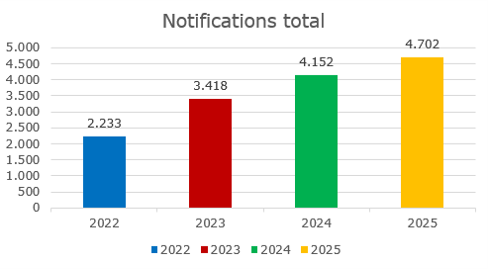
Figure 1: Reports of dangerous products in Safety Gate 2022–2025
Source: own representation, graph based on: https://ec.europa.eu/safety-gate-alerts/screen/search
According to this, an average of 90 reports were submitted to Safety Gate per week in 2025. In 2024, this figure was only 80 reports per week.
Of the 4,702 products complained about, 1,432 were subject to a product recall. The increase in recalled products compared to the previous year was another 14%.
This means that almost one in three affected products had to be recalled – and that is much more than just a sales ban. Manufacturers, importers and retailers face the enormous task of providing consumers with comprehensive information, recalling the products at great expense and either replacing or repairing them. In some cases, these products cannot even be repaired, but must be destroyed at the company’s own expense.
Such recalls not only involve a great deal of organisational effort, but also often cause considerable financial burdens.
The fact that market surveillance authorities are increasingly monitoring online trade is reflected in the fact that 25% of the products complained about were sold online. In 2024, this figure was only 20%.
Looking at the product groups affected, most of the products reported in 2025 were cosmetics. With almost 1,700 products reported, this means that almost every month, 142 different cosmetics were subject to sales bans or even product recalls.
More than 700 reports concerned the product category of toys. Electrical products, including lighting and fairy lights, were classified as dangerous 685 times. Compared to the previous year, this represented growth of 13% for cosmetics, 19% for toys and 17% for electrical products.
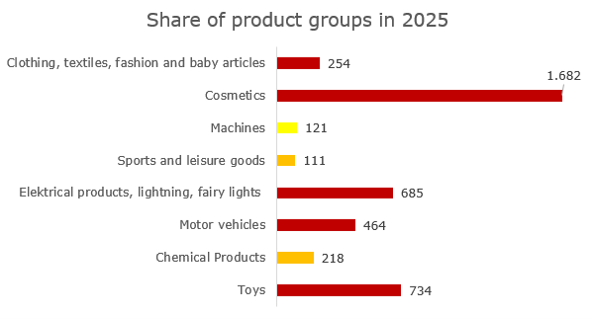
Figure 2: Dangerous products by product group in 2025
Source: own representation, graphic based on: https://ec.europa.eu/safety-gate-alerts/screen/search
The number of clothing items and baby articles criticised decreased slightly compared to the previous year, while increasing numbers were recorded for machines and, above all, sports and leisure articles.
Chemicals were again the number one hazard in 2025. With almost 2,500 reports, chemical risks account for 52% of the products that were rejected and banned. In addition to the nearly 1,700 cosmetics whose main risks were chemical in origin (over 86% of cosmetics contained BMHCA, which is banned in cosmetic products), baby articles, clothing, jewellery, toys, and sports and leisure articles were also affected.
A total of 442 products, or 9.4%, violated the REACH Regulation.
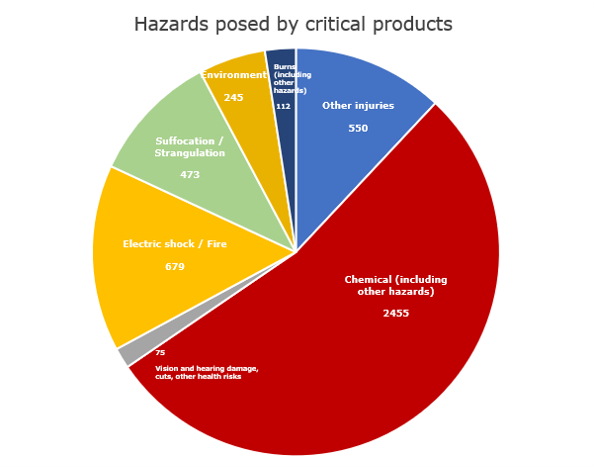
Figure 3: Hazards posed by critical products in 2025
Source: own representation, graphic based on: https://ec.europa.eu/safety-gate-alerts/screen/search
737 or 15.6% of the products complained about posed a risk of burns, cuts, damage to eyesight or hearing, and a wide variety of other injuries. 473 products could lead to suffocation or strangulation, and 679 products could cause electric shocks and/or fires.
Of the 249 products that posed a risk to the environment, 213 violated the RoHS Directive. For this reason, 85.5% of the products were withdrawn from the market and banned from sale. 13 products even had to be recalled from end consumers. This is yet another sign that the authorities are paying increasing attention to compliance with the defined limit values for electrical products and are checking them.
As in previous years, the vast majority of the products that were rejected came from the People’s Republic of China. 2,021 products, or 43%, were imported from this country. The country of origin was unknown for a further 529 hazardous products.
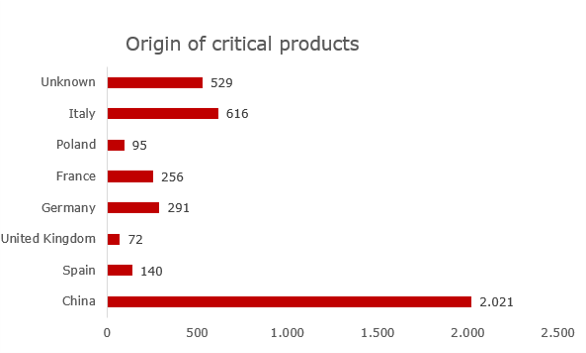
Figure 4: Countries of origin of dangerous products in 2025
Source: own representation, graphic based on: https://ec.europa.eu/safety-gate-alerts/screen/search
Looking only at the 1,500 toys, electrical goods and baby products that were rejected, as many as 83% came from the People’s Republic of China. For a further 8%, the country of origin could not be determined.
Italy was also in second place in terms of rejected products in 2025, as a large number of dangerous cosmetics originated from Italy. This product category was also subject to intensive scrutiny by the Italian and Hungarian market surveillance authorities in 2025.
As in the previous year, most reports in 2025 came from Italy, where an extremely large number of cosmetics were tested and rejected. While Italy submitted relatively few reports in 2022, reports of dangerous cosmetics have been increasing steadily for three years, reaching almost 1,200 in 2025.
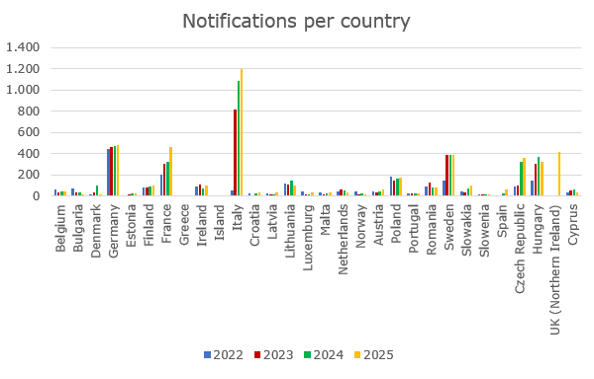
Figure 5: Rapex reports from individual member states 2022–2025
Source: own representation, graph based on: https://ec.europa.eu/safety-gate-alerts/screen/search
Many reports also came from Germany (478), France (461), Sweden (386), Czechia (360) and Hungary (321). These countries have been at a similar level for several years, which suggests that clear structures and processes are established here.
It is interesting to note that in 2025, the United Kingdom reappears as a reporting country, with the note “relating to Northern Ireland”. The reason for this is as follows:
Northern Ireland has a special status after Brexit due to the Northern Ireland Protocol. Many EU product and safety standards continue to apply there, even though it is part of the United Kingdom. That is why reports from the UK appear in the EU Safety Gate with the note “relating to Northern Ireland” to identify products that are only relevant in Northern Ireland under EU law.
Products can therefore be recalled or withdrawn from the market in Northern Ireland, even if they are not problematic in the rest of the UK. After 0 reports in 2024, a total of 418 dangerous products were reported from Northern Ireland in 2025 – a considerable number for such a small country.
At first glance, it stands to reason that populous countries such as Germany, France and Poland report more dangerous products in absolute terms than smaller countries such as Latvia, Luxembourg and Cyprus. But what does the picture look like when population size is taken into account and the number of reports is converted to 1 million inhabitants? This perspective reveals some extremely interesting findings:
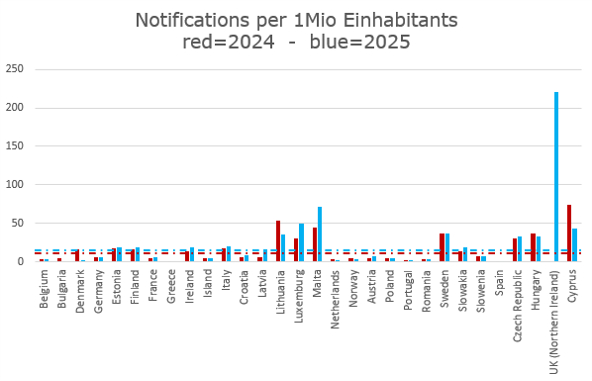
Figure 6: Reports of dangerous products per 1 million inhabitants in 2024 and 2025 (average values dashed)
Source: own representation, graph based on: https://ec.europa.eu/safety-gate-alerts/screen/search
On average, European member states reported a total of approximately 10.3 products per 1 million inhabitants as dangerous in 2025 (based on the population per member state on 1 January 2020 according to Eurostat – indicated by the blue dotted line in Figure 6). This is approximately 1.2 products more than in 2024, when the average value was 9.1 (red dotted line).
Germany is slightly below this average with a factor of 5.7. Northern Ireland is now the frontrunner in this regard with a value of 220. Measured by population, Malta (71.9 reports per million inhabitants), Luxembourg (49.5), Cyprus (43.9), Sweden (37.4), Czechia (33.2) and Hungary (32.9) are also extremely active.
Although Spain has tripled last year’s figure with 66 notifications, it reports very few dangerous products (value: 1.4) in relation to its population. Bulgaria (1.7), the Netherlands (1.9) and Portugal (2.4) also have extremely low values. However, Greece is at the bottom of this category, having not reported a single dangerous product in 2025.
This analysis clearly shows that many smaller countries, relative to their population, are particularly active in the area of market surveillance. At the same time, it raises questions as to why some larger countries appear to carry out very few checks.
Assuming that similarly unsafe products are offered on the markets in Spain, Greece, Bulgaria or Portugal as in other EU countries, it seems difficult to understand why hardly any dangerous products are identified and reported in Safety Gate in these countries.
The significant increase in dangerous products reported to all Member States via Safety Gate clearly shows that market surveillance authorities have apparently tightened their controls.
At the same time, the targeted monitoring of certain product categories in individual countries makes it clear that cooperation between Member States is becoming increasingly close – a step that has serious consequences for companies.
The likelihood of non-compliant products being detected and subject to sales bans or recalls has increased significantly compared to the previous year. For companies, this means a considerably higher risk of financial damage.
Research by Allianz shows that recalls of electrical goods or toys can quickly cost between £650,000 and £1,000,000. Even import bans on medium-sized deliveries can quickly cost between €50,000 and €100,000 – and that’s without the additional costs of contractual penalties or the almost irreparable damage to a company’s image.
The latest developments in Safety Gate clearly show that companies need to prioritise product compliance, random testing and complete documentation even more to avoid major financial losses.
Since December 2024, the new Product Safety Regulation has required internal risk analyses and complete technical documentation even for product areas that were not previously explicitly regulated.
The new EU Packaging Regulation will also come into force in August 2026. From this date onwards, separate declarations of conformity must be issued for packaging. This provides market surveillance authorities with a relatively easy way to check compliance with the regulations – companies should address this issue at an early stage.
Close cooperation with packaging and product suppliers is crucial in this regard. However, in our experience, only a few companies are currently sufficiently prepared, so there is a considerable need for action here.
We support our customers in setting up effective risk management and accompany them throughout the entire conformity assessment process. This includes:
Make an appointment today for a free initial consultation to put your company on a secure footing and minimise potential risks at an early stage.
What do you need to do now? Book our free initial consultation now.
Save €249!!

What do you need to do now? Book our free initial consultation now.
Save €249!!